For most kitchens in the United States, the best electric skillet is a 12- to 16-inch model with steady heat control, a removable cooking pan, a tempered-glass lid, and at least 1,200 watts of power. A removable pan makes cleaning easier. A lid helps with braising and simmering. A wide surface gives you room to cook breakfast, dinner, or food for a small family.
The best choice still depends on how you cook. A compact skillet suits one or two people. A large rectangular skillet works better for pancakes, fried chicken, or family meals. If you want one safe, useful pick, choose a model with an adjustable thermostat, cool-touch handles, a fully immersible removable pan, and a clear U.S. warranty.
Quick answer: Which electric skillet is best?
The best electric skillet for most U.S. homes is a large 12- to 16-inch skillet with a removable nonstick pan and adjustable temperature control.
Look for these features:
- 1,200 to 1,500 watts for strong heat recovery
- A temperature range that reaches at least 400°F
- A removable pan for easier washing
- A tempered-glass lid
- A thick, flat cooking surface
- Cool-touch handles
- A control probe that detaches before cleaning
- A clear warranty and replacement-part support
A basic electric skillet may cost less, but poor heat control can lead to hot spots, slow recovery, or uneven browning. The most expensive model is not always the best. The right size, pan shape, controls, and cleaning design matter more.

What is an electric skillet?
An electric skillet is a countertop pan with a built-in electric heating element. It plugs into a standard U.S. household outlet and uses a thermostat or control dial to manage cooking temperature.
Unlike a stove-top pan, an electric skillet does not need a burner. It can cook eggs, pancakes, grilled sandwiches, meat, vegetables, rice dishes, and shallow fried foods on a table or counter.
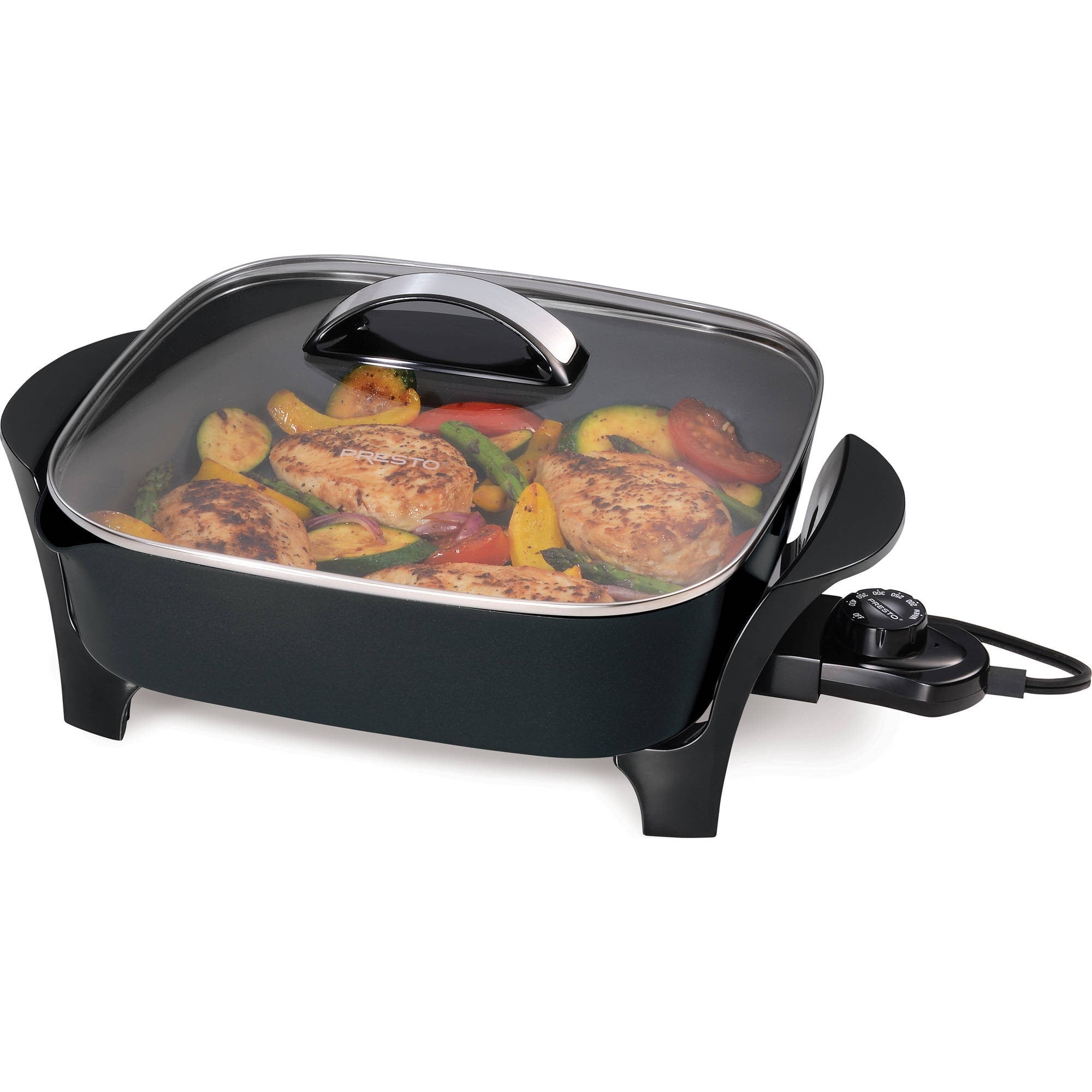
Most electric skillets include four main parts:
- Cooking pan: The metal or cast-aluminum body that holds the food.
- Heating element: The part that transfers heat to the pan.
- Thermostat or control probe: The removable control that sets the temperature.
- Lid: Usually glass or metal, used to trap heat and moisture.
The thermostat cycles power on and off to maintain the selected temperature. This is useful for foods that need steady heat, such as pancakes or simmered sauces. It does not mean every part of the pan stays at exactly the same temperature. Pan thickness, food load, and room temperature still affect results.

How to choose the best electric skillet
Choose an electric skillet by matching its size and controls to your cooking needs. Heat control and cleaning design usually matter more than extra features.
1. Choose the right size
Size affects both cooking space and storage.
| Skillet size | Best for | Main limitation |
|---|---|---|
| 8 to 10 inches | One person, eggs, grilled cheese | Too small for family meals |
| 12 inches | Two to four servings | Less room for large batches |
| 14 to 16 inches | Families, pancakes, meat, one-pan meals | Needs more counter and cabinet space |
| Large rectangular models | Large breakfasts and party food | Often harder to store and wash |
A round 12-inch skillet works well for everyday meals. A 16-inch rectangular skillet gives more usable surface for pancakes, bacon, chicken pieces, or several sandwiches.
Do not judge capacity by the outside measurement alone. Handles and curved sides take up space. Check the inside cooking area and depth before buying.
2. Check the wattage
Wattage shows how much electrical power the appliance can use. It does not guarantee better cooking, but it affects how quickly the pan heats and recovers after cold food is added.
For most U.S. users:
- 800 to 1,000 watts: Suitable for light cooking and small portions
- 1,200 to 1,500 watts: A strong range for family cooking
- More than 1,500 watts: May heat quickly but can increase electrical demand
A high-wattage skillet may draw about 12.5 amps at 1,500 watts on a 120-volt circuit. That can matter if the same circuit also powers a microwave, toaster oven, or coffee maker.
Use the skillet directly in a wall outlet when possible. Avoid overloading a power strip or extension cord. Always follow the product manual.
3. Look for even heat
Even heat helps pancakes brown evenly and reduces burned spots. A thick aluminum pan often spreads heat better than a thin pan.
However, manufacturers do not always publish independent heat maps. A product listing that says “even heating” is a manufacturer claim, not proof of tested performance.
Practical signs of a good design include:
- A thick, flat base
- A heating element that covers much of the cooking area
- A stable thermostat
- A pan that does not warp when heated
- A control dial with clear temperature markings
If the cooking surface has a very hot center and cool edges, you may need to move food during cooking. That is a limitation of the appliance, not always a cooking mistake.
4. Prioritize useful temperature control
An adjustable thermostat is more useful than a few preset buttons. It lets you choose low heat for simmering and higher heat for browning.
Common settings include:
- Warm or low: Holding cooked food
- 250°F to 300°F: Gentle cooking and simmering
- 325°F to 375°F: Pancakes, eggs, vegetables, and many skillet meals
- 400°F and above: Browning and searing, depending on the model
The dial marking is not the same as the temperature inside every piece of food. Use a food thermometer for meat, poultry, leftovers, and other foods that need a safe internal temperature.
5. Compare the cooking surface
Most electric skillets use a nonstick coating. It reduces the need for oil and makes cleanup easier.
A nonstick surface can wear out if you:
- Use metal utensils
- Cut food in the pan
- Heat the empty pan for a long time
- Stack heavy cookware on it
- Use abrasive pads
- Put it in the dishwasher when the manual says not to
Ceramic-coated surfaces may appeal to shoppers who prefer that type of coating, but “ceramic” does not automatically mean more durable. The coating, base material, care instructions, and warranty all matter.
Do not use a damaged pan. If the coating is badly scratched, peeling, or flaking, replace the pan or the appliance according to the manufacturer’s guidance.
6. Check how the pan cleans
Cleaning is one of the biggest differences between electric skillet designs.
The easiest design usually has:
- A removable control probe
- A removable pan
- A fully immersible pan
- A smooth cooking surface
- Few seams where grease can collect
Never place the thermostat or electrical control in water. Even if the pan is removable, read the manual before using a dishwasher. Some pans are dishwasher safe, while others can lose their finish or suffer damage.
7. Consider the lid and handles
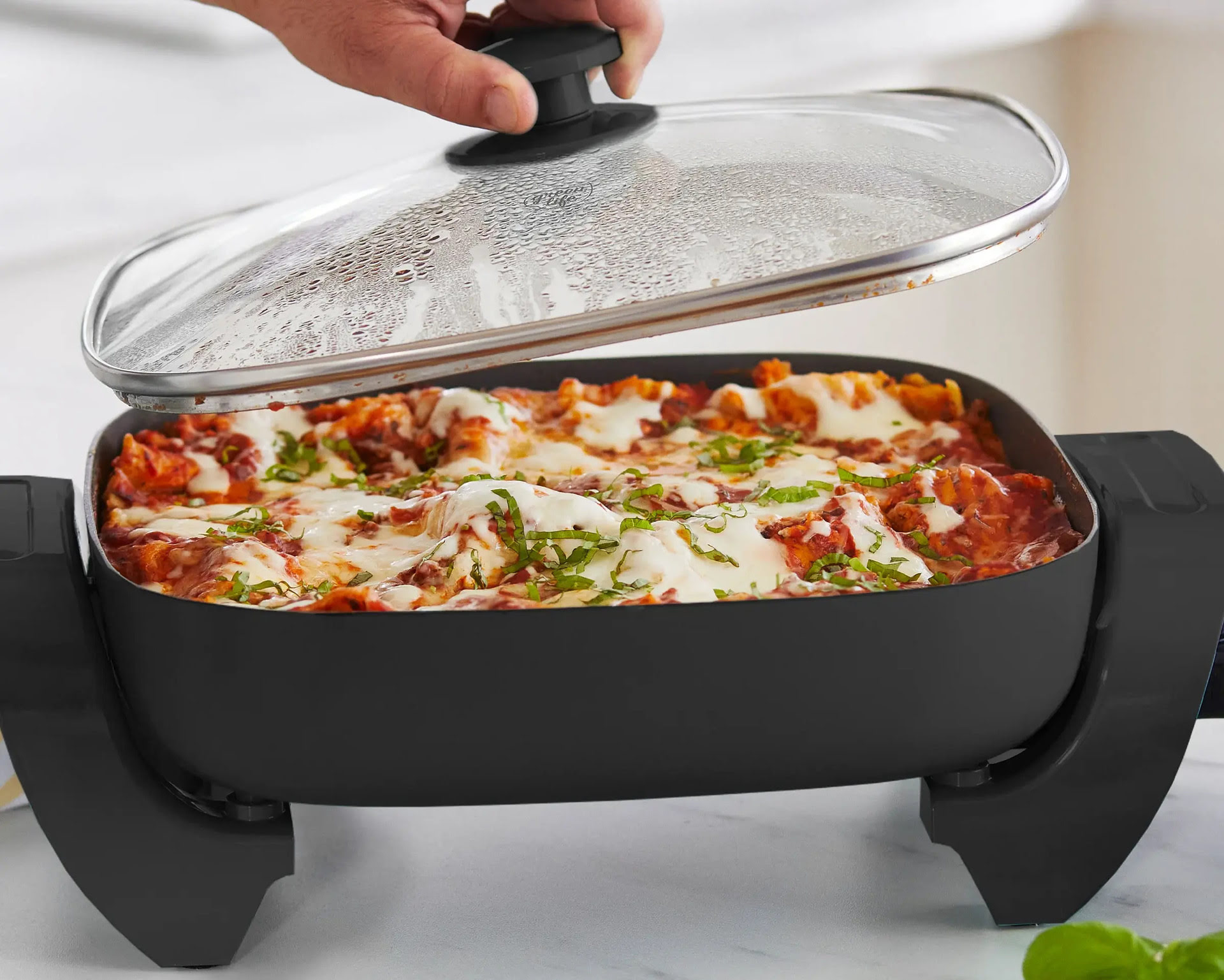
A glass lid lets you check food without releasing as much heat. A small steam vent can help control pressure and reduce rattling.
The lid should have:
- A sturdy handle
- A secure fit
- A steam vent
- Heat-resistant parts
- A shape that does not drip condensation onto the counter
Handles should stay cool enough to move the skillet safely, but “cool touch” does not mean they remain cold under every condition. Use oven mitts when moving a hot or full skillet.

Best electric skillet types for different cooks
There is no single best design for every U.S. household. The best type depends on portion size, storage space, and cooking style.
Best for most families: a 12- to 16-inch rectangular skillet
A large rectangular skillet offers the most cooking area. It works well for pancakes, French toast, bacon, burgers, chicken, and one-pan meals.
Choose this style if you often cook for three or more people. Its main drawbacks are weight and storage. Measure your cabinet or pantry before buying.
Best for small kitchens: a compact round skillet
A compact skillet uses less counter space and may be easier to store. It suits eggs, grilled cheese, quesadillas, and small portions.
It is less useful for batch cooking. Food may crowd the pan, which can cause steaming instead of browning.
Best for simmered meals: a deep electric skillet
A deep skillet can hold sauces, stews, rice dishes, and braised food. The extra depth also helps reduce splatter.
A deep pan is not always the best choice for pancakes or large flat foods. Check the usable flat area, not just the total capacity.
Best for frequent cleaning: a removable-pan model
If you cook often, a removable pan can save time. You can wash the cooking body without carrying the whole appliance to the sink.
The electrical control must still remain dry. Remove it before washing the pan.
Best for simple cooking: a basic dial model
A basic dial model may be the best value if you want reliable cooking without digital controls. Fewer parts may also mean fewer electronic components to fail.
A digital display can improve precision, but it does not prove better heat distribution. Choose digital controls only if you value timer functions, exact settings, or a clearer display.
Electric skillet comparison: what matters most?
The most important trade-off is usually size versus storage, followed by easy cleaning versus long-term coating care.
| Feature | Why it helps | What to watch for |
|---|---|---|
| Removable pan | Easier washing | The control probe must stay dry |
| Glass lid | Lets you see food | Glass can break if mishandled |
| Nonstick coating | Less oil and simple cleanup | Can wear with rough use |
| High wattage | Better heat recovery | May use more circuit capacity |
| Deep sides | Good for stews and sauces | Less useful for flat foods |
| Rectangular shape | More room for batches | Takes more storage space |
| Digital controls | Clear settings and timers | More parts and possible failure points |
| Dishwasher-safe parts | Convenient cleaning | Confirm which parts are approved |
A useful buying rule is to spend more on pan construction, thermostat quality, and warranty support before paying extra for decorative features.
What size should you buy?
Use this simple guide:
- Choose 8 to 10 inches for one person.
- Choose 12 inches for two to four servings.
- Choose 14 to 16 inches for family meals or batch cooking.
- Choose a deep model if you often make stews, sauces, or braised dishes.
Leave room around the appliance for heat and steam. Do not place it directly under cabinets if the lid or steam vent could damage the cabinet finish.

How to use an electric skillet safely
Use the skillet on a stable, heat-resistant surface. Keep the cord away from the edge of the counter and away from hot surfaces.
Follow these steps:
- Inspect the cord, plug, pan, and control. Do not use the appliance if any part is cracked, frayed, or damaged.
- Place the skillet on a level surface. Keep it away from water and flammable items.
- Attach the thermostat before heating. Follow the manual for your model.
- Preheat only as directed. An empty nonstick pan can overheat if left unattended.
- Add food after the pan reaches the needed temperature.
- Use wood, silicone, or approved plastic tools.
- Check food with a thermometer when safety depends on internal temperature.
- Turn off and unplug the appliance after cooking.
- Let it cool before cleaning.
The U.S. Department of Agriculture recommends cooking poultry to 165°F, ground meats to 160°F, and whole cuts of beef, pork, veal, and lamb to 145°F with a three-minute rest. These are internal food temperatures, not skillet settings. Verify current guidance at USDA.gov.
Do not use an electric skillet outdoors unless the manual clearly permits outdoor use. Keep the plug and control away from water. A ground-fault circuit interrupter, or GFCI, may be required in damp locations, but it does not make an appliance waterproof.

Common electric skillet mistakes
Many poor results come from crowding, weak temperature control, or incorrect cleaning.
Crowding the pan
Too much food lowers the cooking temperature. Moisture then builds up, and food may steam instead of brown.
Cook in batches when food touches or overlaps. This matters most for meat, potatoes, and frozen foods.
Moving food too soon
Pancakes, fish, and meat may stick before a crust forms. Give food time to release naturally, but lower the heat if the surface starts to burn.
Trusting the dial without checking food
A setting such as 350°F describes the thermostat target. It does not confirm that the center of a thick piece of food is safe to eat.
Use an instant-read thermometer for foods that require a safe internal temperature.
Washing the control probe
The control probe contains electrical parts. Remove it before washing the pan, and never submerge it unless the manufacturer expressly says it is safe.
Using too much oil
An electric skillet can make frying easy, but excess oil increases splatter and cleanup. Use enough oil for the recipe and keep the temperature under control.
Storing the lid carelessly
Glass lids can chip or break if placed under heavy cookware. Store the lid where it will not be struck or exposed to sudden temperature changes.

How to clean and maintain an electric skillet
Clean the skillet after it cools. Unplug it first, then remove the temperature control if the design allows it.
For most models:
- Wipe away loose food with a soft cloth or paper towel.
- Wash the pan with warm water, mild dish soap, and a soft sponge.
- Clean the lid according to its manual.
- Wipe the control probe with a damp cloth only.
- Dry every part before storage.
- Store the pan without sharp tools inside it.
Do not pour cold water into a very hot pan. Sudden temperature changes can damage some surfaces or warp the pan.
Replace the appliance if the cord becomes frayed, the thermostat behaves erratically, the pan warps, or the coating is badly damaged. Manufacturer parts and warranty service can affect the real value of an electric skillet, so check support before purchase.

Electric skillet versus other cookware
An electric skillet is useful because it combines a wide pan with its own heat source. It is not better than every alternative.
Electric skillet versus frying pan
A frying pan gives you more control over the burner and may be easier to store. An electric skillet gives you a large, steady cooking surface without taking up a stove burner.
Electric skillet versus griddle
A griddle has a flatter surface and suits pancakes, bacon, and sandwiches. An electric skillet has deeper sides and a lid, so it handles more types of meals.
Electric skillet versus slow cooker
A slow cooker is better for long, unattended cooking at low heat. An electric skillet is better for browning, shallow frying, and quick one-pan meals.
Electric skillet versus countertop induction burner
An induction burner can heat compatible cookware quickly and offers flexible pan choice. An electric skillet gives you a matched pan and often a larger cooking area, but you cannot easily replace its cooking vessel.

Are electric skillets worth buying?
An electric skillet is worth buying if you need extra cooking space, want to cook without using the stove, or often prepare large batches.
It may not be worth buying if your kitchen has little storage, you already own a large griddle, or you rarely cook for more than one person. A skillet also adds another appliance to clean and store.
Before buying, ask:
- Will I use the extra cooking area?
- Can I store a 12- to 16-inch appliance?
- Is the pan easy to wash?
- Can I find replacement parts?
- Does the electrical rating suit my kitchen?
- Will I use the lid and temperature control?
The best value is the model you will use often and clean without trouble.
Frequently asked questions
What is the best electric skillet brand?
There is no single best brand for every buyer. Choose a brand that provides clear specifications, a removable pan, a reliable thermostat, replacement parts, and a U.S. warranty. Brand reputation matters, but the exact model and its care instructions matter more.
Can you cook raw meat in an electric skillet?
Yes. An electric skillet can cook raw meat when the pan reaches a suitable heat and the food reaches a safe internal temperature. Use a food thermometer rather than judging doneness by color alone.
Can an electric skillet replace a frying pan?
It can replace a frying pan for many tasks, including eggs, pancakes, burgers, vegetables, and shallow frying. It may not replace a frying pan for high-heat searing, oven finishing, or cooking directly over a gas flame.
Can you put an electric skillet in the dishwasher?
Only put parts in the dishwasher when the manufacturer says they are dishwasher safe. Never place the electrical control probe in water unless the manual clearly permits it.
What temperature is best for pancakes in an electric skillet?
A setting near 350°F often works well for pancakes, but the correct setting varies by skillet and batter. Preheat the pan, test one pancake, and lower the heat if the outside browns before the center cooks.
How long do electric skillets last?
Service life depends on the thermostat, cord, pan coating, cleaning habits, and frequency of use. A well-maintained skillet may last for years, but a worn nonstick surface or faulty control can make replacement necessary sooner.
Final recommendation
For most U.S. households, choose a 12- to 16-inch electric skillet with a removable nonstick pan, adjustable thermostat, tempered-glass lid, cool-touch handles, and 1,200 to 1,500 watts.
Choose a smaller round model if you cook for one or two people. Choose a large rectangular model if you prepare family meals or batch breakfasts. Choose a deep skillet for sauces and stews. Above all, favor easy cleaning, stable temperature control, safe electrical design, and a warranty over flashy features.
A good electric skillet should make cooking simpler—not create another difficult appliance to manage.