The Zojirushi Home Bakery Mini Breadmaker BB-HAC10 is the best small bread maker for most people in the United States who want a compact machine and small, 1-pound loaves. It takes up less space than many 2-pound models and suits singles, couples, small kitchens, and households that do not eat bread every day.
If you want larger loaves, more program choices, or a lower-cost option, the Cuisinart Compact Automatic Bread Maker CBK-110 is a stronger alternative. It makes loaves up to 2 pounds but still has a smaller footprint than many full-size bread machines.
The right choice depends on more than price. Loaf size, counter space, bread texture, program options, noise, cleaning, and replacement parts all affect the value of a small bread maker.

Quick answer: Which small bread maker should you buy?
Choose the Zojirushi Home Bakery Mini if your top priorities are:
- A truly compact bread machine
- Small 1-pound loaves
- Simple daily operation
- A machine for one or two people
- Less leftover bread
Choose the Cuisinart CBK-110 if you need:
- Loaves from about 1 to 2 pounds
- More flexibility for family use
- A compact design without moving to a 1-pound machine
- Programs for basic bread, gluten-free bread, jam, and other recipes
Choose the Hamilton Beach HomeBaker 29882 if you want a basic 2-pound bread maker at a lower price and do not mind a larger machine.
Best small bread makers at a glance
| Model | Best for | Maximum loaf size | Main advantage | Main limitation |
|---|---|---|---|---|
| Zojirushi Home Bakery Mini BB-HAC10 | Small households | 1 pound | Smallest practical loaf size | Fewer programs and a higher price for its size |
| Cuisinart CBK-110 | Best balance | 2 pounds | Compact body with flexible loaf sizes | Takes more space than a 1-pound machine |
| Hamilton Beach HomeBaker 29882 | Lower-cost baking | 2 pounds | Straightforward controls and common recipes | Larger footprint and less refined control |
| Zojirushi Home Bakery Supreme BB-PDC20 | Larger households that still want automation | 2 pounds | Strong program range and dual paddles | Not a truly small bread maker |
These specifications come from manufacturer product information and manuals. Retail packages, available colors, prices, warranties, and included accessories can change, so check the current U.S. listing before buying.

What makes a bread maker “small”?
A small bread maker may mean one of two things: a machine with a small physical footprint or one that makes small loaves. These are related, but they are not the same.
A 2-pound bread machine may have a compact body but still produce more bread than a single person can eat. A 1-pound machine may be a better fit if you want fresh bread without storing half a loaf.
Small loaf size
Bread makers commonly list loaf sizes such as:
- 1 pound
- 1.5 pounds
- 2 pounds
A 1-pound loaf is often enough for one or two people. A 1.5-pound loaf may suit a couple or a small family. A 2-pound loaf is more practical for three or more people or for households that freeze bread.
The final loaf size varies by recipe. A dense whole-wheat loaf and a light white loaf may not have the same volume, even when they use similar weights of flour.
Small counter footprint
Measure the space where you plan to use the machine. Include room above the unit if the lid opens upward. Also leave space near the sides for ventilation and safe handling.
Do not judge size by width alone. Bread makers can be tall, deep, or awkward to store in a cabinet. A machine that fits on the counter may still be difficult to lift or remove after each use.
Small batch does not mean weak performance
A compact bread maker can produce good bread when the recipe matches the machine. The pan, kneading paddle, heater, and program timing are designed around a target amount of dough.
Using a recipe meant for a 2-pound machine in a 1-pound bread maker can cause overflow or poor baking. Using too little dough in a large pan can produce a short, uneven loaf.

Best overall: Zojirushi Home Bakery Mini BB-HAC10
The Zojirushi Home Bakery Mini BB-HAC10 is the best small bread maker when compact size and small loaves matter most. It is designed around a 1-pound loaf, which helps reduce waste for people who do not need a full-size loaf.
The machine uses a vertical pan. This shape helps keep the body narrow, which can be useful in small U.S. kitchens, apartments, dorm-style spaces, or crowded counters.
Why it stands out
The Mini is a good fit for:
- One-person households
- Couples
- People who bake bread once or twice a week
- Small kitchens
- Users who prefer fresh bread over storing leftovers
Its documented programs include basic bread and other common functions, though the exact program list should be checked in the current U.S. manual. A compact bread maker usually gives up some specialty programs in exchange for its smaller size.
What to consider before buying
The main trade-off is capacity. A 1-pound loaf may feel too small if your household eats sandwiches often or if you want bread for several days.
The machine may also cost more than some larger entry-level models. That can seem unusual, but compact appliances often use specialized designs rather than simply scaled-down versions of larger machines.
The vertical loaf shape may also differ from the wider supermarket-style loaf many Americans expect. That does not affect basic baking, but it can change slice size and sandwich fit.
Best for
Buy the Zojirushi Mini if you want the smallest practical loaf size and a compact machine, and you accept fewer programs and a higher cost per pound of bread.

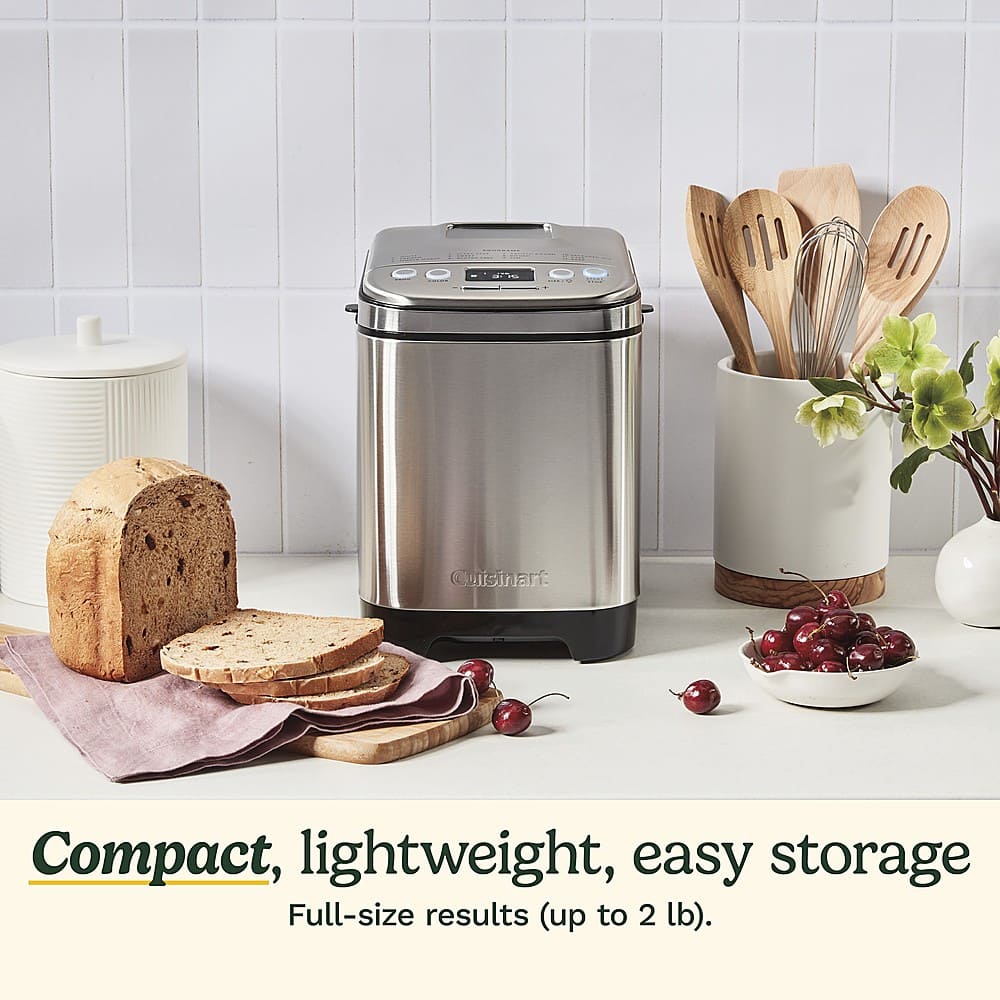
Best compact 2-pound option: Cuisinart CBK-110
The Cuisinart Compact Automatic Bread Maker CBK-110 is the best choice for many households that want a small bread maker but still need a full-size loaf. It offers multiple loaf sizes and crust settings in a body designed for countertop use.
This model is more flexible than a 1-pound machine. You can bake smaller loaves when needed, then choose a larger loaf when family or guests need more bread.
Why it is a strong choice
The Cuisinart CBK-110 is useful for:
- Couples who sometimes need more bread
- Small families
- New bread-machine users
- People who want several automatic programs
- Bakers who want a compact unit without limiting every loaf to 1 pound
Manufacturer documentation lists programs for common bread types and other functions. Depending on the recipe and selected setting, the machine may support basic white bread, whole wheat, French-style bread, sweet bread, gluten-free recipes, dough, jam, and baking-only functions.
Always use the manual for the exact ingredient limits. “Gluten-free” programs do not make every recipe safe for people with celiac disease if ingredients, utensils, or the kitchen have been exposed to gluten.
Limitations
Although the CBK-110 is marketed as compact, it is not as small as a 1-pound bread maker. Its 2-pound capacity also makes it easier to bake more bread than you can use.
The machine may be a better value than the Zojirushi Mini for a household that wants flexibility. It is not automatically the better choice for a person who has very little storage space or dislikes leftovers.
Best for
Choose the Cuisinart if you want the best balance of compact design, loaf-size flexibility, and automatic programs.

Best budget-style choice: Hamilton Beach HomeBaker 29882
The Hamilton Beach HomeBaker 29882 is a practical choice for shoppers who want a basic bread machine without paying for premium design features. It is generally aimed at home users who want automatic mixing, kneading, rising, and baking.
Its 2-pound capacity makes it more suitable for families than the Zojirushi Mini. It may also be easier to find through major U.S. retailers, although current stock and model versions can vary.
Strengths
The Hamilton Beach HomeBaker is a reasonable choice for:
- First-time users
- Families that want standard-size loaves
- People who mostly bake white or wheat bread
- Users who want a simple control panel
- Buyers who care more about price than the smallest footprint
Limits
This is not the best model if your first concern is a very small loaf. A 2-pound bread maker can produce more bread than one or two people need.
It may also offer less control over timing, customization, and specialty recipes than more advanced machines. Budget bread makers can still make good bread, but ingredient measurement and recipe choice become especially important.
Best for
Choose the Hamilton Beach if price and simple operation matter more than the smallest possible size or premium controls.

How to choose the best small bread maker
The best small bread maker should match your household, recipes, and available space. Use the following factors before comparing prices.
1. Match the loaf size to your household
Use this general guide:
| Household need | Useful loaf size |
|---|---|
| One person or occasional baking | 1 pound |
| Two people | 1 to 1.5 pounds |
| Small family | 1.5 to 2 pounds |
| Frequent sandwich bread | 2 pounds or more |
This is only a starting point. People who freeze bread may prefer a larger machine. People who eat bread slowly may prefer a 1-pound model, even in a family home.
2. Check the pan shape
A horizontal pan often creates slices that resemble store-bought sandwich bread. A vertical pan saves counter width but may create taller, narrower slices.
Neither design is universally better. Choose a horizontal pan if sandwich size matters. Choose a vertical pan if width is the main space problem.
3. Count the programs you will use
More programs do not always mean better results. Most users rely on a small group of settings:
- Basic white bread
- Whole wheat bread
- Dough
- Rapid bread
- Gluten-free bread
- Bake-only
- Jam or preserve settings
A machine with 20 programs may add little value if you only use three. On the other hand, a dedicated gluten-free setting can be useful if you already have tested gluten-free recipes.
4. Look for delayed start and keep-warm functions
A delayed-start timer lets you load ingredients at night and wake up to freshly baked bread. The keep-warm function can hold the loaf warm after baking, but it may make the crust darker or the bread drier if used for too long.
Do not use delayed start with ingredients that spoil at room temperature, such as fresh milk, eggs, or some dairy products, unless the manufacturer’s instructions specifically allow it. Use shelf-stable substitutes or bake immediately.
5. Check the kneading paddle
Most bread makers use a removable paddle. Some paddles remain in the loaf after baking and leave a small hole. A few machines use design features intended to reduce this issue, but no system removes the trade-off completely.
Check whether the paddle, pan, and replacement parts are available in the United States. A low purchase price is less attractive if a worn pan cannot be replaced.
6. Consider noise and movement
Kneading can create vibration. A lightweight machine may move on a smooth counter, especially when making stiff dough.
Place the machine on a stable, heat-resistant surface. Do not run it near the edge of a counter, under low cabinets, or where the cord can be pulled.

How to use a small bread maker successfully
A bread maker does most of the work, but it cannot correct wrong measurements. Follow the recipe and ingredient order in the manual.
Basic setup
- Place the bread pan in the machine.
- Attach the kneading paddle.
- Add ingredients in the order listed by the manufacturer.
- Measure flour with a scale when possible.
- Select the correct loaf size and crust color.
- Start the program.
- Check the dough during the first kneading cycle if the manual permits it.
- Remove the bread when the cycle ends.
- Cool the loaf before slicing.
Many bread-machine recipes add liquids first, then dry ingredients, with yeast placed last. Some machines use a different order. The manual for the specific model takes priority.
Measure flour by weight
Flour can become packed when measured by volume. A cup of flour may hold different amounts depending on how it enters the cup.
A kitchen scale gives more consistent results. If you use measuring cups, spoon flour into the cup and level it without pressing it down.
Watch the dough, not just the timer
During the first kneading cycle, the dough should form a soft, smooth ball. It should not look like dry crumbs or a liquid paste.
If the dough is dry, add liquid one teaspoon at a time. If it is wet and spread out, add flour one tablespoon at a time. Make small changes because too much added flour or water can quickly change the loaf.
Cool before slicing
Fresh bread continues to set after baking. Cutting it too soon can crush the center and make the crumb seem gummy.
Move the loaf to a cooling rack when the cycle ends, using oven mitts. Let it cool before slicing, unless the manual gives a different instruction.

Common small bread maker problems
Most poor results come from incorrect measurements, old yeast, unsuitable recipes, or the wrong program.
| Problem | Likely causes | What to check |
|---|---|---|
| Loaf does not rise | Old yeast, too much salt, cool liquid, wrong program | Check yeast date, recipe, and liquid temperature |
| Loaf rises and collapses | Too much liquid, too much yeast, excess sugar | Weigh flour and follow the recipe closely |
| Dense bread | Too little liquid, too much flour, weak yeast | Check the dough during kneading |
| Pale crust | Light crust setting, low sugar, short cycle | Use the correct crust option |
| Burned crust | Too much sugar, dark crust setting, long keep-warm time | Reduce browning and remove bread promptly |
| Paddle stays in loaf | Normal design behavior | Use the hook supplied with the machine |
| Machine moves | Heavy dough or smooth counter | Use a stable, level surface |
| Bread sticks to pan | Pan coating wear or insufficient cooling | Do not use metal tools; check pan condition |
Do not use a damaged pan, frayed cord, or cracked paddle. Unplug the machine before cleaning or removing stuck parts.
Never immerse the main appliance in water. Clean the bread pan according to the manual, since harsh scrubbing can damage its coating.
Is a small bread maker cheaper than store-bought bread?
A small bread maker is not always cheaper than supermarket bread. The answer depends on ingredient prices, loaf size, energy use, how often you bake, and whether you avoid wasted bread.
A simple cost estimate is:
Cost per loaf = ingredients + estimated electricity + equipment cost per loaf
For example, if a loaf uses $1.25 of ingredients, electricity adds an estimated $0.10, and the machine costs $120 spread across 150 loaves, the equipment cost is $0.80 per loaf. The estimated total is:
$1.25 + $0.10 + $0.80 = $2.15 per loaf
This is a hypothetical calculation, not a guaranteed cost. Your local electricity rate, ingredient prices, and machine life will change the result.
A bread maker can still offer value through control over ingredients, fresh bread, and fewer store trips. It may not save money if you bake rarely or discard unused bread.

Small bread maker safety and food handling
Use a bread maker on a stable, dry surface away from water. The exterior, lid, pan, and bread can become hot during and after baking.
Keep hands, utensils, and clothing away from the kneading paddle while the machine operates. Unplug the appliance before cleaning or inspecting the pan.
For recipes with eggs, milk, cheese, or other perishable ingredients, avoid long room-temperature delays unless the manufacturer specifically approves them. Food safety depends on the full recipe and time at room temperature, not just the machine’s timer.
A gluten-free setting does not prevent cross-contact with wheat. If someone in your household has celiac disease or a serious wheat allergy, use separate ingredients and equipment where needed, and follow guidance from a qualified medical or food-safety source.

Frequently asked questions
Is a 1-pound bread maker enough for two people?
Usually, yes. A 1-pound loaf can suit two people who eat bread slowly or want fresh bread more often. A 1.5- or 2-pound model is better if you make sandwiches daily or freeze extra slices.
Can a small bread maker make gluten-free bread?
Some models include a gluten-free program. Results depend on the recipe, ingredients, and cross-contact controls. A program does not make a shared kitchen safe for someone with celiac disease by itself.
Can I use regular bread recipes in a bread maker?
You can use many recipes, but they may need adjustment. Bread-machine recipes are designed for the pan size, kneading pattern, and program timing. Do not exceed the manufacturer’s maximum ingredient limits.
Is a bread maker better than a stand mixer?
A bread maker is more automatic because it can mix, knead, proof, and bake in one container. A stand mixer gives you more control over shaping, loaf style, and oven baking. Choose a bread maker for convenience and a stand mixer for flexibility.
How long does homemade bread last?
Fresh bread often tastes best within one or two days, but storage depends on the recipe and room conditions. Let the loaf cool before storing it. A sealed container can soften the crust, while refrigeration may make bread stale faster. Freeze extra slices if you will not eat the loaf soon.
Do small bread makers need special flour?
Most use regular bread flour, all-purpose flour, or whole-wheat flour, depending on the recipe. Some recipes need vital wheat gluten or other ingredients. Use the flour named in the model’s manual or a tested recipe.
Final recommendation
The Zojirushi Home Bakery Mini BB-HAC10 is the best small bread maker for a single person or couple that wants compact storage and 1-pound loaves.
The Cuisinart CBK-110 is the better all-purpose choice if you want a compact machine but still need 1.5- or 2-pound loaves. The Hamilton Beach HomeBaker 29882 makes sense for shoppers who want basic bread-making functions at a lower entry price.
Before buying, measure your counter and storage space, decide how much bread your household eats, check the current U.S. manual, and confirm that replacement pans and paddles are available. Those simple checks matter more than a long list of automatic programs.