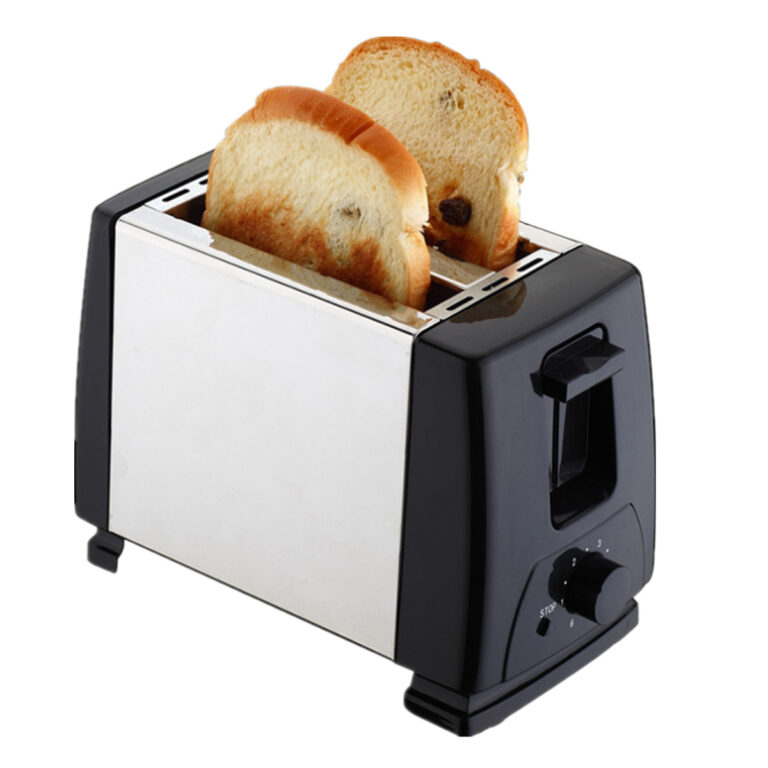
In U.S. kitchens, a toaster oven is a small countertop appliance built for toast, reheating, and small meals. A convection oven is an oven that uses a fan to move hot air around the food. The key difference is that “toaster oven” describes the appliance type, while “convection” describes how an oven heats and circulates air.
Many toaster ovens now include a convection setting. A full-size range oven may also have convection. So, these terms are not always opposites.
A toaster oven with convection is small, quick, and useful for one or two people. A full-size convection oven offers more space, more even heat for large dishes, and better capacity for family cooking.

Quick Answer: Toaster Oven vs. Convection Oven
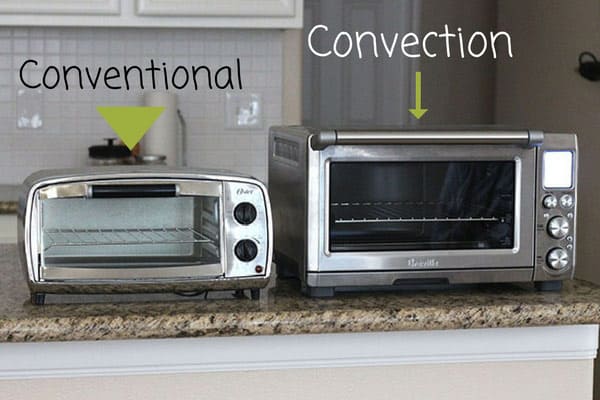
A toaster oven is a compact countertop oven with heating elements above and below the food. It may use still air or a fan-assisted convection mode.
A convection oven uses a fan to move heated air. It may be a full-size wall oven, range oven, or small toaster oven.
| Feature | Toaster oven | Full-size convection oven |
|---|---|---|
| Main design | Small countertop oven | Range or wall oven |
| Heat method | Bake, broil, toast, and sometimes convection | Bake, roast, broil, and convection |
| Capacity | Small to medium | Medium to large |
| Preheating | Usually faster | Usually slower |
| Best for | Toast, snacks, small meals, reheating | Large meals, roasting, baking, and multiple dishes |
| Energy use per small meal | Often lower because the cavity is small | Often higher for small portions |
| Installation | Plug-in countertop appliance | Built into a range or wall |
| Fan included? | Only on convection models | Only on convection models |
| Pan size | Small baking pans | Standard full-size baking pans |
The simplest rule is this: choose a toaster oven when convenience and small portions matter most. Choose a full-size convection oven when capacity, large dishes, and multi-rack cooking matter most.
What Is a Toaster Oven?
A toaster oven is a compact electric oven that sits on a countertop. It uses heating elements to cook food in a small chamber.
Most toaster ovens offer several modes:
- Toast
- Bake
- Broil
- Reheat
- Warm
- Air fry or convection, on some models
The heating elements turn on and off to control the temperature. Basic models rely mostly on radiant heat from the elements. More advanced models add a fan to circulate hot air.
How a toaster oven works
When you select a setting, the appliance sends power to one or more heating elements. A thermostat measures the temperature and cycles the elements as needed.
The food cooks through a mix of:
- Radiant heat from the elements
- Hot air inside the cavity
- Heat transfer from the pan or rack
Because the oven chamber is small, it often reaches cooking temperature faster than a full-size oven. That can make it practical for toast, frozen snacks, sandwiches, vegetables, and small portions of meat.
A toaster oven does not always cook like a convection oven. Unless the product has a fan-assisted convection setting, the air inside the chamber is mostly still.
What Is a Convection Oven?
A convection oven uses a fan to move hot air around the food. This airflow can reduce hot and cold spots and improve browning.
A convection oven may be:
- A full-size oven in a kitchen range
- A wall oven
- A countertop toaster oven with a fan
- A countertop convection oven marketed for baking or roasting
The word convection refers to the cooking process, not the oven’s size.
How convection cooking works
In a standard oven, hot air naturally rises while cooler air falls. This creates air movement, but it is slow and uneven.
A convection fan pushes hot air across the food. The moving air can:
- Transfer heat to food more quickly
- Brown exposed surfaces more evenly
- Reduce temperature differences within the oven
- Help some foods develop a crisp exterior
The fan does not make every food cook perfectly. Pan shape, food size, rack position, oven calibration, and airflow all affect the result.
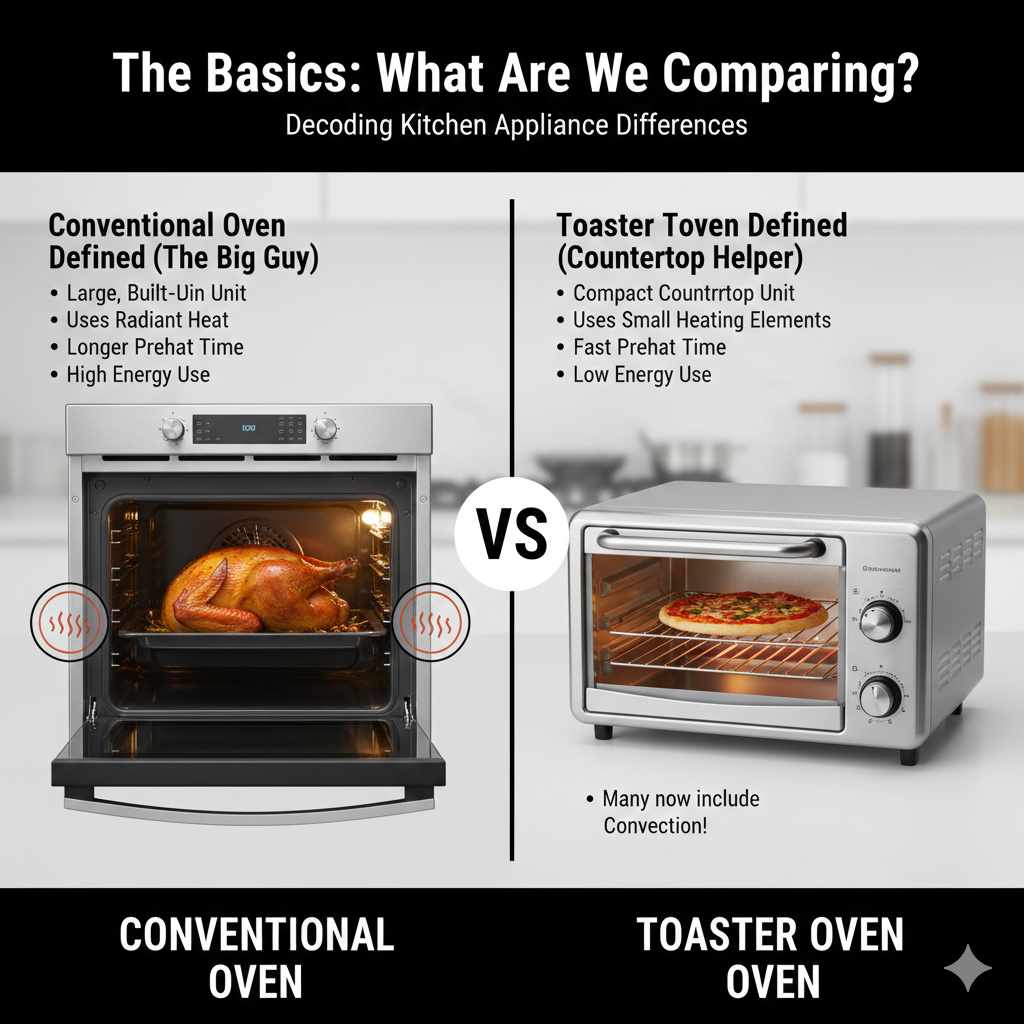
The Main Differences Between a Toaster Oven and a Convection Oven
The biggest differences are size, airflow, capacity, speed, and cooking flexibility.
1. Appliance type versus cooking method
This is the most important distinction.
A toaster oven is a type of countertop appliance. Convection is a heating and airflow method. Therefore, a toaster oven can be either:
- A conventional toaster oven without a fan
- A convection toaster oven with a fan
A full-size oven can also be either conventional or convection.
Calling a small oven a “convection oven” does not automatically mean it has the same capacity or performance as a full-size convection oven.
2. Cooking capacity
A toaster oven has a smaller cavity. It may fit toast, a small baking dish, or a small pizza. The exact capacity varies by model.
A full-size convection oven can usually hold:
- A large roasting pan
- A standard sheet pan
- Multiple casserole dishes
- Larger cuts of meat
- Several racks of food
This makes a full-size oven more useful for family meals and holiday cooking.
3. Preheating speed
A toaster oven usually preheats faster because it has less air and less interior material to heat. Some models need little or no preheating for simple tasks such as toast or reheating.
A full-size oven has a larger cavity. It often takes longer to reach the target temperature, especially when used for baking or roasting.
Preheating still matters for foods that depend on a precise starting temperature. Follow the recipe and the appliance manual.
4. Cooking speed
A convection fan may shorten cooking time, but the result depends on the food and the oven.
A small toaster oven may cook quickly because:
- The heating elements sit close to the food
- The cavity is small
- Less air must be heated
- Some models use strong top heat
This can be helpful, but it can also cause fast browning or burning. Check food early when using a toaster oven for the first time.
5. Energy use
A small toaster oven may use less total energy for a small meal because it heats a smaller space. That does not mean it is always more efficient for every task.
A full-size oven may make more sense when you need to cook:
- Several dishes at once
- A large roast
- Multiple trays
- Food for a large group
The practical comparison is not only the appliance’s power rating. It is also the amount of food cooked and the time the appliance runs.
6. Pan and dish size
Toaster ovens need smaller pans that fit safely inside the cavity. Some models cannot hold a standard 18-by-13-inch half-sheet pan.
A full-size oven can usually accommodate standard U.S. baking pans and larger cookware. Always leave space around the pan so hot air can move and the food does not touch the heating elements.
7. Heat control
A full-size oven often provides more stable heat because of its larger walls, insulation, and cavity. A toaster oven can have more direct heat from nearby elements.
This difference matters most for:
- Cakes
- Cookies
- Bread
- Delicate pastries
- Foods that brown quickly
A toaster oven may need a lower rack, a lighter pan, or an earlier check. Use an oven thermometer if you suspect the displayed temperature is inaccurate.
Does a Convection Toaster Oven Cook Better?
A convection toaster oven can cook some foods more evenly than a basic toaster oven. The fan moves hot air around the food and may improve browning and crisping.
It is often useful for:
- Roasted vegetables
- French fries
- Chicken pieces
- Fish fillets
- Small pizzas
- Frozen foods
- Toasted sandwiches
However, convection does not guarantee better results for every dish. A fan can dry delicate food or make the surface brown before the center is done.
For cakes, custards, soufflés, and other sensitive foods, use the recipe’s convection guidance. If the recipe gives only conventional-oven instructions, the appliance manual may suggest a temperature adjustment. A common starting point is to reduce the temperature by about 25°F, but this is not universal. Check the food early and use a thermometer when appropriate.
Which One Should You Use?
The right choice depends on the food, serving size, and space available.
Use a toaster oven when you need to:
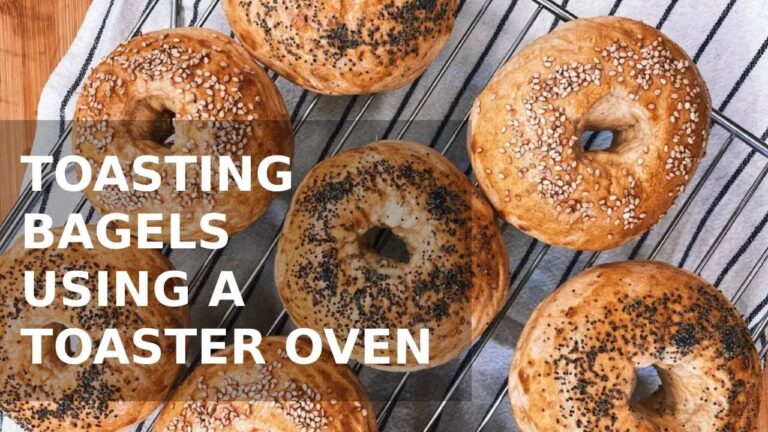
- Toast bread or bagels
- Reheat pizza without using a large oven
- Cook one or two portions
- Roast a small tray of vegetables
- Heat frozen snacks
- Make a small baked meal
- Avoid heating a full-size oven for a small task
A toaster oven is especially useful in apartments, offices, dorms where allowed, and small households. It can also serve as a second cooking appliance during busy meal times.
Use a full-size convection oven when you need to:
- Roast a turkey or large cut of meat
- Bake several trays at once
- Cook a large casserole
- Prepare food for several people
- Use standard-size baking equipment
- Cook several dishes at different temperatures or on multiple racks
A full-size oven gives you more room and more control for large meals.
Use a conventional oven setting when:
- The recipe specifically requires conventional heat
- The food is delicate
- A fan may dry the surface
- The dish needs slow, gentle cooking
- The recipe has already been tested for that oven mode
You can often adapt a recipe, but watch the food closely the first time.
Toaster Oven vs. Convection Oven: Cooking Examples
The best appliance changes with the task.
| Cooking task | Usually better choice | Reason |
|---|---|---|
| Two slices of toast | Toaster oven | Fast and compact |
| One frozen pizza | Toaster oven if it fits | Avoids heating a large oven |
| Large homemade pizza | Full-size oven | More room and stronger capacity |
| Two servings of roasted vegetables | Convection toaster oven | Small cavity and moving air |
| Whole turkey | Full-size oven | A toaster oven is too small for most birds |
| One casserole | Either | Choose based on dish size |
| Several cookie trays | Full-size convection oven | More rack and pan space |
| Reheating fried food | Convection toaster oven | Air movement can restore some crispness |
| Custard or cheesecake | Conventional setting | Gentle, still heat may be better |
| Toasting nuts | Either, with close monitoring | Small ovens brown food quickly |
These are general guidelines. The appliance’s manual and the cookware size can change the answer.
Can You Use a Toaster Oven Instead of a Convection Oven?
You can use a toaster oven for many foods that would normally go in a full-size oven, as long as the food and cookware fit safely.
Before substituting, check:
- The pan fits without touching the heating elements.
- The door closes fully.
- Air can move around the pan.
- The food does not block vents.
- The oven supports the required temperature.
- The cooking mode matches the recipe.
- The food reaches a safe internal temperature.
A small toaster oven may require a smaller batch. Crowding the pan can block airflow and cause uneven cooking.
For meat, poultry, seafood, eggs, casseroles, and leftovers, use a food thermometer. The U.S. Department of Agriculture states that poultry should reach 165°F, while many other foods have different safe minimum temperatures.
Safety Differences and Common Mistakes
Both appliances can cause burns, fires, or foodborne illness when used incorrectly.
Keep the toaster oven away from hazards
Place it on a stable, heat-resistant surface. Keep towels, paper, curtains, cabinets, and other flammable items away from the appliance.
Do not place objects on top of the toaster oven unless the manual allows it. The exterior and upper vents can become hot.
Do not use unsafe cookware
Use cookware labeled for oven use. Avoid plastic containers unless the manufacturer clearly states that they are oven-safe.
Do not use glassware that is not rated for the cooking temperature. Sudden temperature changes can cause some glass dishes to break.
Watch the broiler setting
Broiling uses intense heat from the upper element. Food can burn quickly in a small toaster oven.
Stay nearby, use the correct rack position, and follow the manual. Never leave broiling food unattended.
Avoid blocked airflow
Do not cover vents. Do not line the oven floor with foil unless the manufacturer specifically permits it. Foil can block airflow, touch heating elements, or cause unsafe heat buildup.
Keep the food and pan away from the elements. Grease and crumbs should not collect near the heating surfaces.
Clean grease and crumbs
Crumbs can smoke or ignite. Grease can create flare-ups and unpleasant odors.
Unplug the appliance and let it cool before cleaning. Follow the manufacturer’s cleaning instructions. Do not immerse an electric oven in water.
Check food temperature
Color and cooking time do not prove that food is safe. Insert a food thermometer into the thickest part of meat or the center of a casserole.
The USDA’s food safety guidance is a reliable source for safe internal temperatures and storage practices.

Common Mistakes When Choosing Between the Two
Mistake 1: Assuming every toaster oven has convection
Many do not. Look for a fan, a “convection” button, or a manual that describes fan-assisted cooking.
Mistake 2: Treating all convection ovens as equal
A small countertop model and a large wall oven can differ in fan strength, heating element placement, temperature accuracy, and usable space.
Mistake 3: Using full-size pans in a small oven
A pan that sits too close to the elements can brown food too quickly or create a safety risk. Measure the interior before buying cookware.
Mistake 4: Following the same time without checking
A toaster oven may cook the outside faster than a full-size oven. Start checking early, especially for toast, thin foods, and items placed near the top element.
Mistake 5: Overcrowding the food
Convection needs room for air to move. A crowded pan can trap moisture and create uneven browning.
Mistake 6: Choosing by wattage alone
Wattage shows electrical power, not the complete cooking result. Cavity size, insulation, fan design, controls, and heating element placement also matter.
Key Takeaways
- A toaster oven is a small countertop oven.
- Convection is a fan-assisted cooking method.
- Some toaster ovens have convection; others do not.
- A full-size convection oven is better for large meals and several pans.
- A toaster oven is usually more convenient for small portions and quick reheating.
- Convection may improve browning and cooking uniformity, but it can also brown food too quickly.
- Use the appliance manual, check food early, and measure internal temperatures for safety.
Frequently Asked Questions
Is a toaster oven the same as a convection oven?
No. A toaster oven is an appliance type. A convection oven is an oven that uses a fan to circulate hot air. A toaster oven may include a convection setting.
Is a convection toaster oven better than a regular toaster oven?
It can be better for roasting, browning, and crisping small portions. A regular toaster oven may be simpler for toast and basic reheating. The better option depends on the foods you cook most often.
Does a convection oven cook faster than a toaster oven?
Not always. A small toaster oven may preheat and cook quickly because its cavity is small. A convection fan can speed heat transfer, but oven size, food thickness, temperature, and pan placement also matter.
Can I bake a cake in a toaster oven?
Yes, if the toaster oven can hold the pan and maintain the required temperature. Use a pan that leaves space around it, avoid crowding, and check the cake early. A full-size oven may provide more even results for large or delicate cakes.
Is a toaster oven cheaper to run than a full-size oven?
It may use less total energy for a small meal because it heats a smaller space. The result depends on cooking time, power use, food quantity, and the specific appliances. For a large meal, a full-size oven may be more practical.
Should I lower the temperature in a convection oven?
Many recipes use a lower temperature for convection cooking, but the correct adjustment varies. Some recipes and appliance manuals recommend reducing the temperature by about 25°F. Follow the recipe or manual, then check the food early.
Can I use aluminum foil in a toaster oven?
Only if the manufacturer’s instructions allow it and the foil does not block vents, cover the oven floor, or touch heating elements. Improper foil use can cause overheating or fire.
Final Recommendation
Choose a toaster oven for small portions, fast reheating, toast, snacks, and everyday countertop cooking. Choose a full-size convection oven for large dishes, family meals, multiple pans, and foods that benefit from spacious, moving-air cooking.
If you are comparing two specific appliances, check four details first: interior dimensions, convection availability, temperature range, and the cookware sizes that fit. Those details matter more than the label alone.