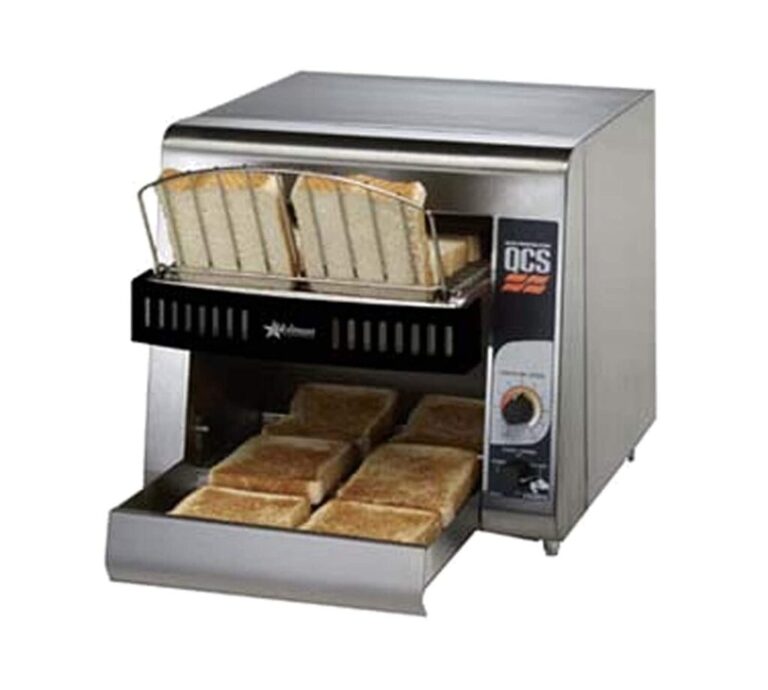
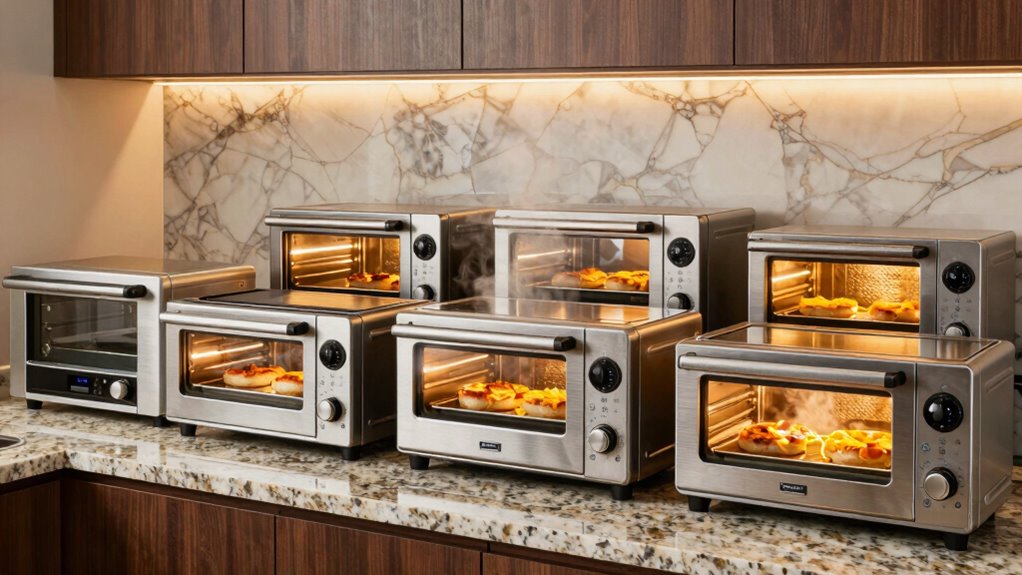
In U.S. kitchens, a toaster oven looks like a small countertop oven with a glass door, a metal body, and control buttons or dials on the front. It is usually wider and deeper than a pop-up toaster but much smaller than a standard wall oven.
Most toaster ovens have a front door that opens downward, a wire rack inside, and a shallow baking tray. Some models also include an air-fry basket, convection fan, or digital display.
What Does a Toaster Oven Look Like?
A toaster oven looks like a compact rectangular box made for a kitchen counter. Its front face has a glass window, a handle, and controls for temperature, cooking mode, and time.
The outside is often made from stainless steel, painted metal, or heat-resistant plastic. The inside has metal walls and one or more rack positions.
A typical toaster oven includes these visible parts:
- Glass door: Lets you watch food as it cooks.
- Door handle: Opens the door and helps keep hands away from heat.
- Control panel: Holds knobs, buttons, or a touchscreen.
- Wire rack: Supports toast, food, or baking pans.
- Baking tray: Catches crumbs, grease, and food drips.
- Heating elements: Metal rods near the top and bottom of the cooking area.
- Vent openings: Release heat and steam.
- Power cord: Connects the appliance to a U.S. electrical outlet.
- Crumb tray: Collects loose crumbs and is often removable.
The exact design changes by model. A basic toaster oven may have three dials and a plain metal body. A larger model may look more like a small built-in oven, with a digital screen and many cooking settings.
How Big Is a Toaster Oven?
A toaster oven is usually small enough to sit on a kitchen counter, but its size can vary greatly. The outside dimensions depend on how much food the oven can hold.
| Toaster oven type | Common visual size | What it may hold |
|---|---|---|
| Compact toaster oven | Small and narrow | Toast, snacks, and small meals |
| Standard countertop toaster oven | Medium rectangle | Several slices of toast or a small baking dish |
| Large toaster oven | Wide and deep | A larger pan, several servings, or a small pizza |
| Toaster oven with air fry | Medium to large | Food in a mesh basket with room for hot air |
| Countertop convection oven | Often tall or wide | Baking pans, roasting dishes, or multiple foods |
These size groups are general. Product dimensions and interior capacity differ among brands and models.
The inside cooking area matters more than the outside appearance. A toaster oven may look large but have less usable space because of thick insulation, sloped sides, or heating elements.
Before placing one on a counter, measure:
- The appliance’s width, height, and depth.
- The counter space available.
- The space above and around the appliance.
- The distance from the appliance to cabinets, walls, and other items.
- The location of the electrical outlet.
Follow the clearance instructions in the owner’s manual. A toaster oven needs open space for heat to escape.
What Does the Inside of a Toaster Oven Look Like?
Inside, a toaster oven looks like a small oven chamber lined with metal. It usually has a dark interior, a wire rack, and heating elements positioned near the top and bottom.
The heating elements are narrow metal tubes or rods. When the oven is turned on, they become hot and transfer heat to the food. Some models use exposed elements that are easy to see. Others cover them with a metal shield.
Most toaster ovens have adjustable rack slots. You can place the rack higher or lower depending on the food:
- A higher rack may place food closer to the top heating element.
- A lower rack gives taller food more space.
- A middle rack is often useful for general baking and reheating.
The bottom of the oven may contain a removable crumb tray. This tray helps catch crumbs and small food pieces. It is not always designed to hold large spills or liquid food.
Some toaster ovens include extra parts:
- A baking pan
- A broiling pan
- A wire broiling rack
- An air-fry basket
- A pizza pan
- A removable interior rack
- A rotisserie spit on select models
Do not assume that every tray or rack can be used in every cooking mode. Check the manual, especially when using broil, convection, or air-fry settings.
What Are the Controls on a Toaster Oven?
The controls are usually on the front, beside or below the door. Older and basic models often use mechanical dials. Newer models may use buttons, a digital screen, or a touch panel.
A toaster oven commonly has controls for:
- Cooking mode: Selects bake, broil, toast, warm, or air fry.
- Temperature: Sets the target heat.
- Timer: Controls how long the oven runs.
- Toast shade: Adjusts how light or dark toast becomes.
- Start or stop: Begins or ends the cooking cycle.
- Convection: Turns on a fan that moves hot air.
- Light: Illuminates the cooking chamber on some models.
A simple toaster oven may have three knobs:
- Function
- Temperature
- Timer
A digital toaster oven may show the selected mode, temperature, cooking time, and remaining time.
The labels can differ. For example, “toast,” “bake,” and “broil” do not always use the same heating pattern. Read the manual if the symbols are unclear.
How Is a Toaster Oven Different From a Pop-Up Toaster?
A pop-up toaster has vertical slots on top. A toaster oven has a horizontal cooking chamber with a door.
A pop-up toaster is built mainly for slices of bread. A toaster oven can toast bread, but it can also heat or cook many other foods.
| Feature | Pop-up toaster | Toaster oven |
|---|---|---|
| Main shape | Tall or narrow body | Small horizontal oven |
| Opening | Bread slots on top | Front door |
| Cooking area | Narrow slots | Enclosed rack space |
| Typical foods | Bread, bagels, and waffles | Toast, pizza, vegetables, baked foods, and leftovers |
| Controls | Toast shade and time | Temperature, mode, and time |
| Accessories | Usually none | Rack, tray, and sometimes air-fry basket |
A toaster oven is also different from a microwave oven. A microwave usually has a solid door with a small viewing screen and often a rotating glass turntable. A toaster oven has visible heating elements, a wire rack, and a metal cooking tray.
A toaster oven may replace some uses of a full-size oven, but it does not always provide the same interior space. It is best viewed as a small countertop oven, not as a large oven with all the same capacity.
What Types of Toaster Ovens Look Different?
Toaster ovens share the same basic form, but several types have distinct shapes and features.
Basic toaster oven
A basic toaster oven is usually a compact metal box with three or four controls. It may have a simple glass door and one wire rack.
This style is easy to identify because it has few settings and a traditional appliance design.
Convection toaster oven
A convection toaster oven looks like a standard toaster oven but includes a fan inside. The fan may be visible through vents on the back or side.
The fan moves hot air around the food. This can change cooking results and may require adjustments to time or temperature. Follow the recipe and the appliance manual.
Air-fryer toaster oven
An air-fryer toaster oven often looks larger than a basic model. It may include a mesh basket instead of, or in addition to, a solid baking tray.
The basket allows heated air to circulate around food. The outside may have a larger digital control panel because air-fry models often include several preset programs.
Rotisserie toaster oven
A rotisserie toaster oven may include a motor, side supports, and a long spit rod. These parts allow food to turn while it cooks.
The appliance may be taller or deeper to provide room for the rotating food. Keep enough clearance around the oven so the door can open fully and the food can turn safely.
Toaster oven with hot plates
Some countertop units combine a toaster oven with one or two cooking surfaces on top. They look taller and wider than ordinary toaster ovens.
These combination units need extra care because the top surface can become hot. Do not place items on top unless the manual says the surface is safe for that use.
What Should You Look for When Identifying a Toaster Oven?
Look for a horizontal chamber, a front-opening door, and heating elements. These features separate a toaster oven from most other countertop appliances.
Use this visual checklist:
- Does it have a front door with a viewing window?
- Is there a wire rack inside?
- Are there heating elements above or below the rack?
- Does it have a temperature control?
- Does it have a timer or cooking display?
- Does it include a crumb tray?
- Is the product label marked “toaster oven” or “countertop oven”?
- Does the manual list toast, bake, broil, or similar functions?
A toaster oven may be mistaken for a small microwave if the door and control panel look similar. The interior provides the clearest clue. A toaster oven has heating rods and racks. A microwave usually has a turntable or flat microwave-safe floor instead.
A toaster oven may also resemble a compact air fryer. The difference is that many air fryers use a pull-out drawer or basket, while a toaster oven uses a front door and oven racks. Some products combine both designs.
Where Should a Toaster Oven Sit?
Place a toaster oven on a stable, level, heat-resistant surface with the ventilation space required by the manufacturer.
Keep it away from:
- Sink edges and splashing water
- Paper towels and curtains
- Plastic containers
- Wooden items that can be damaged by heat
- The edge of the counter
- Crowded areas where the door cannot open
- Overhead cabinets that do not provide enough clearance
Do not use a toaster oven inside a closed cabinet or enclosed shelf unless the manufacturer specifically permits that setup. Heat can build up around the appliance.
The U.S. Consumer Product Safety Commission advises consumers to follow appliance safety instructions and reduce fire risks around heating devices. The manufacturer’s manual is the main source for model-specific clearance, cookware, cleaning, and electrical guidance.
Never cover the appliance while it is operating. Unplug it when the manual recommends doing so, when cleaning it, or when it will not be used for a long period.
Common Mistakes When Looking at a Toaster Oven
The most common mistake is judging a toaster oven by its outside size alone. The usable cooking area can be smaller than expected.
Watch for these issues:
Confusing exterior size with interior capacity
A wide appliance may have a shallow interior. Check the listed interior dimensions and the largest pan size that the manufacturer supports.
Ignoring the door swing
Most toaster oven doors open downward. Leave enough room in front for the door and hot rack to extend safely.
Assuming every tray is broiler-safe
Some trays are designed for baking but not for direct exposure to high heat. Use only cookware approved in the manual.
Blocking ventilation openings
Vents help release heat. Blocking them may cause overheating or damage.
Placing the oven under a cabinet
The space above the toaster oven can become hot. Use the clearance listed in the instructions.
Using it like a storage box
Do not store bread, pans, paper, or plastic items inside the toaster oven. An item left inside can burn when the oven is turned on.
Touching the glass or metal body
The door, exterior, racks, and food can become hot. Use the handle and suitable oven mitts.
Frequently Asked Questions
Is a toaster oven bigger than a toaster?
Yes. A toaster oven is usually wider and deeper than a pop-up toaster because it has an enclosed cooking chamber. It also has a door, rack, and heating elements.
Does a toaster oven look like a microwave?
They can look similar from the outside, but their interiors differ. A toaster oven has racks and visible heating elements. A microwave usually has a microwave-safe cooking floor or turntable.
Does a toaster oven need to be plugged in?
Yes. A standard electric toaster oven needs a suitable electrical outlet. Use the power requirements listed on the product label and in the manual. Do not use a damaged cord or loose outlet.
Can a toaster oven fit a regular baking pan?
Some large toaster ovens can fit small standard pans, but many cannot fit a full-size U.S. baking sheet. Check the interior dimensions and the manufacturer’s stated pan size before buying or using one.
Does a toaster oven have an open flame?
Most household electric toaster ovens do not use an open flame. They use electric heating elements. Gas-powered specialty ovens are a different type of appliance and require different installation and safety rules.
Conclusion
A toaster oven looks like a small countertop oven with a glass front door, metal housing, adjustable rack, crumb tray, and heating elements. Basic models use knobs, while larger convection and air-fryer models may have digital controls, fans, and extra accessories.
The best way to identify one is to look for its horizontal cooking chamber and front-opening door. If you are choosing a model, compare the interior size, rack positions, controls, ventilation needs, and included accessories—not just the outside appearance.
For the next step, measure your available counter space and the largest dish or pan you want to use. Then compare those measurements with the product’s interior dimensions and clearance instructions.