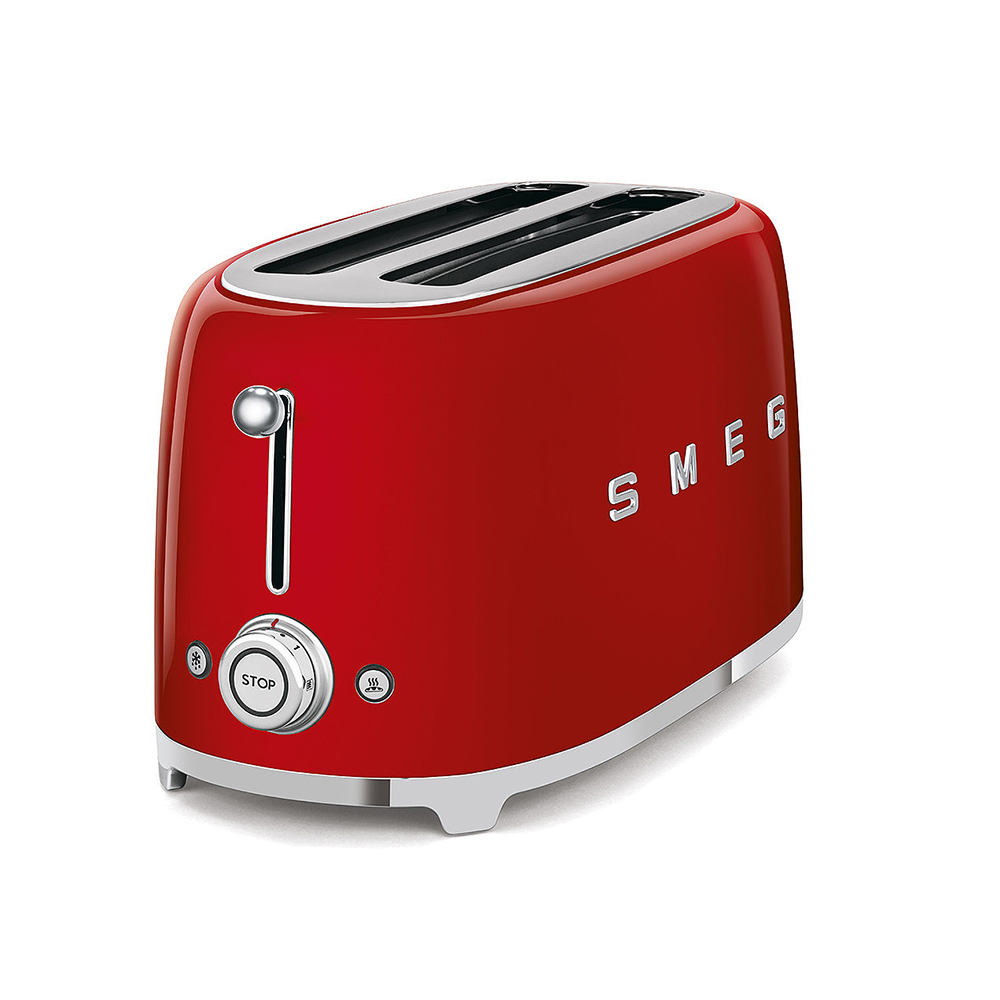
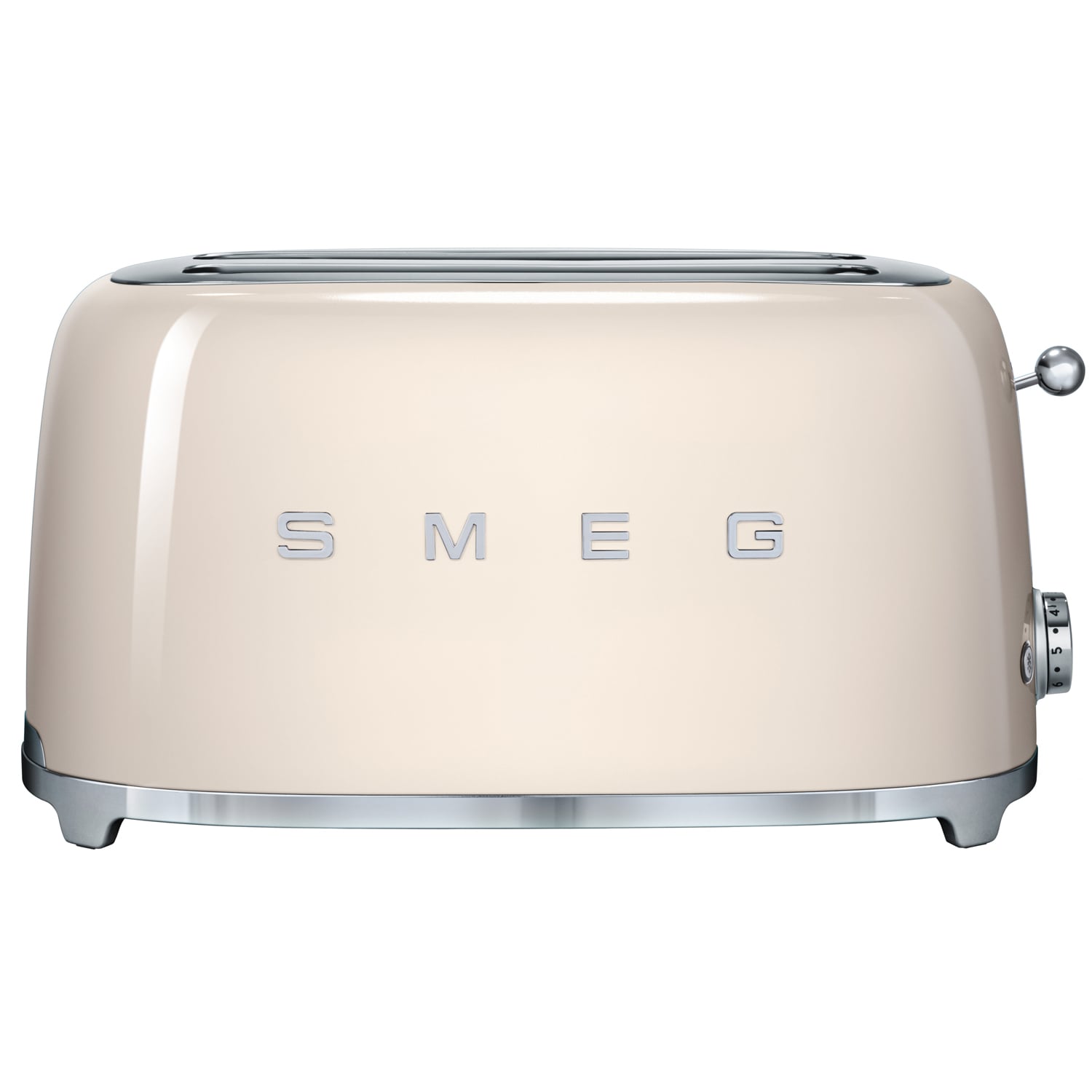
A Smeg toaster is an electric countertop toaster made by Smeg, an Italian appliance company known for its retro-inspired “50s Style” design. In the United States, Smeg sells two-slice, four-slice, and long-slot toaster models, depending on the current product range.
Most Smeg toasters combine a metal body, rounded edges, colored finishes, browning controls, automatic pop-up action, and removable crumb trays. The main difference from a basic toaster is the design, build materials, and added controls—not a completely different way of making toast.
What does the Smeg toaster name mean?
Smeg is an Italian appliance brand founded in 1948 by the Bertazzoni family in Guastalla, Italy. The name comes from the Italian phrase Smalterie Metallurgiche Emiliane Guastalla, which refers to the company’s early metalwork business.
The company now makes large and small kitchen appliances. Its toaster range is best known for its curved, colorful design. Smeg calls this look its 50s Style collection.
A Smeg toaster is still a standard pop-up toaster. It uses electric heating elements to brown bread placed in a slot. A lever lowers the bread, the elements heat it, and the toaster raises it when the cycle ends.
The word “Smeg” does not describe a special type of toaster. It identifies the brand and product line.
Main Smeg toaster types sold in the U.S.
| Type | Typical use | Main advantage |
|---|---|---|
| Two-slice toaster | One or two people | Takes less counter space |
| Four-slice toaster | Families or shared kitchens | Toasts more slices at once |
| Long-slot toaster | Artisan bread, sourdough, or longer slices | Fits bread that may not fit standard slots |
Exact controls, colors, dimensions, and included features can vary by model and sales region. Check the product page and manual for the specific U.S. model.

How does a Smeg toaster work?
A Smeg toaster works by passing electric current through heating elements. The elements become hot and brown the exposed surfaces of the bread.
The browning dial does not usually measure the bread’s color directly. Instead, it sets the heating time or operating cycle. A higher setting generally produces darker toast, while a lower setting produces lighter toast.
Most Smeg toaster models include these controls:
- Browning control: Selects the toast level.
- Cancel button: Stops the cycle and raises the bread.
- Reheat function: Warms toast for a short cycle without starting a full browning cycle.
- Defrost function: Helps toast frozen bread.
- Self-centering racks: Hold slices near the heating elements for more even browning.
- Automatic pop-up: Raises the toast when the cycle ends.
- Removable crumb tray: Collects crumbs for easier cleaning.
Not every control appears on every Smeg model. Some models may include a bagel setting or other functions, so read the manual before use.
What the heating process means for your toast
Bread thickness, moisture, sugar, and temperature all affect the result. A thin, dry slice may brown faster than a thick slice of fresh bread. Frozen bread needs more time than room-temperature bread.
For a consistent result:
- Use slices of similar thickness.
- Start with a middle browning setting.
- Check the first cycle.
- Adjust the dial based on the result.
- Use the same bread type when comparing settings.
A numbered setting is not a universal shade rating. “4” on one model may not match “4” on another model.

What features does a Smeg toaster have?
Smeg toaster features vary by model, but the range commonly focuses on control, convenience, and appearance.
Browning settings
Many Smeg toaster models use six browning levels. These settings let you choose from light to dark toast. The setting is a starting point, not a guarantee, because bread type and moisture change the outcome.
Reheat and defrost functions
The reheat function is useful when toast has cooled but does not need much more browning. The defrost function is designed for frozen slices.
Do not assume that defrosting and reheating work the same way. Defrost normally uses a longer cycle to help warm frozen bread. Reheat normally uses a shorter cycle.
Self-centering slots
Self-centering racks move toward the bread so the slice sits more evenly between the heating elements. This can help produce more balanced browning, especially with thinner slices.
It does not guarantee perfect browning. Uneven bread thickness, different moisture levels, or an aging heating element can still affect the result.
Removable crumb trays
The crumb tray catches loose bread particles. Emptying it often helps reduce buildup inside the toaster.
A crumb tray does not make the appliance safe to wash under water. The toaster should be unplugged and kept dry during cleaning.
Independent controls on four-slice models
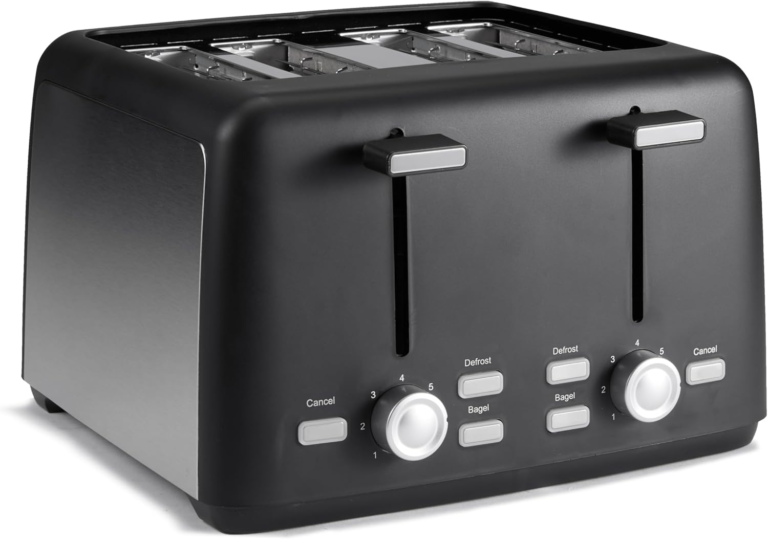
Four-slice Smeg toasters commonly divide the slots into two pairs. Each pair may have its own browning dial and function buttons.
This lets two people toast different types of bread at the same time. For example, one pair can run at a lighter setting while the other uses a darker setting.
Confirm the control layout for the exact model. Product names and features can change by market.

Is a Smeg toaster worth it?
A Smeg toaster may be worth the cost for a buyer who values its appearance, finish, and matching kitchen design. It may be less attractive for someone who only wants the lowest-cost way to make toast.
The practical decision comes down to design versus price, along with the controls and size you need.
Reasons to consider one
- The retro design may suit a kitchen with colorful or vintage-style appliances.
- Two-slice and four-slice formats support different household sizes.
- Long-slot models may fit larger or irregular slices.
- Browning, reheat, and defrost controls offer more control than a very basic toaster.
- Matching Smeg appliances may create a consistent visual style.
Reasons to compare alternatives
- A decorative finish does not prove better toast.
- A similar toaster from another brand may cost less.
- Replacement parts and service options may differ by model and location.
- A large four-slice toaster uses more counter space.
- Bright colors and glossy finishes may show fingerprints or crumbs more clearly.
Smeg’s design is a documented product feature. Claims about better taste, longer life, or more even browning require model-specific testing and should not be assumed from the brand name alone.
Smeg toaster compared with a basic toaster
| Factor | Smeg toaster | Basic toaster |
|---|---|---|
| Design | Retro styling and multiple finish options | Usually simple and functional |
| Controls | Often includes browning, reheat, and defrost controls | May include only browning and cancel |
| Price | Often positioned above entry-level models | Usually lower |
| Capacity | Two-slice, four-slice, or long-slot options | Depends on model |
| Toast quality | Depends on model, bread, and settings | Also depends on model, bread, and settings |
| Counter space | Can be larger, especially four-slice models | Often more compact |
| Main appeal | Style plus standard toaster functions | Low cost and basic utility |
Which Smeg toaster size should you choose?
Choose the size based on your bread, household, and counter space—not only on the number of people in your home.
Choose a two-slice Smeg toaster if:
- You usually make one or two slices at a time.
- You have limited counter space.
- You want a smaller appliance.
- You rarely serve several people at once.
Choose a four-slice Smeg toaster if:
- Several people eat toast at the same time.
- You want to toast four slices in one session.
- You need separate controls for different preferences.
- You have enough space behind the appliance for safe cord placement.
Choose a long-slot model if:
- You often buy sourdough or artisan bread.
- Standard slots do not fit your preferred bread.
- You want to toast longer slices without cutting them first.
Measure your available counter space before buying. Include room around the toaster and make sure the lever and buttons remain easy to reach.
Do not place a toaster under a low cabinet if the manual warns against it or if rising heat could affect the cabinet. Keep the appliance away from sinks, wet surfaces, curtains, and other materials that can catch fire.

How to use a Smeg toaster safely
Use the toaster on a stable, dry surface and follow the manual for your exact model. U.S. buyers should also check the rating label and use a compatible household outlet.
Follow these steps:
- Place the toaster on a level, heat-resistant surface.
- Make sure the crumb tray is in place.
- Put bread into the slot without forcing it.
- Lower the lever.
- Select a moderate browning setting.
- Press a special function only when needed.
- Let the toaster finish or press cancel to stop it.
- Remove the toast carefully.
- Unplug the toaster if the manual or your household practice requires it after use.
Never insert a knife, fork, spoon, or other metal object into a plugged-in toaster. If bread becomes stuck, unplug the toaster and allow it to cool fully before trying to remove it. Do not shake or strike the appliance.
Do not toast food with loose fillings, dripping cheese, wet coatings, or packaging. These materials can cause smoke, sticking, or fire.
Stop using the toaster if you see damaged wiring, sparks, a burning smell that does not clear, a lever that will not stay down, or heating elements that behave unusually. Contact Smeg or a qualified appliance repair service rather than opening the housing yourself.

How do you clean a Smeg toaster?
Clean the crumb tray often and keep the outside dry. Regular crumb removal is the main routine task.
- Unplug the toaster.
- Wait until it is completely cool.
- Remove and empty the crumb tray.
- Wipe the tray with a dry or slightly damp cloth, if the manual allows it.
- Wipe the exterior with a soft, damp cloth.
- Dry all parts before replacing the tray.
- Return the toaster to service only when it is dry.
Do not immerse the toaster in water. Do not pour water into the slots. Do not use abrasive pads or harsh cleaners that could damage the finish.
Turn the toaster upside down only if the manufacturer’s instructions permit it. Never shake a plugged-in toaster, and do not use tools to scrape the heating elements.
Cleaning cannot repair a faulty heating element, damaged cord, or failed control. Those problems need service or replacement.

Common Smeg toaster problems and fixes
Many toaster problems come from bread size, crumbs, settings, or power supply. Check simple and safe causes first.
| Symptom | Possible cause | Safe first check |
|---|---|---|
| Toast is too light | Low setting or short cycle | Increase the setting slightly |
| Toast is too dark | High setting or dry bread | Lower the setting |
| One side browns more | Uneven bread or element issue | Try a different slice; seek service if it continues |
| Lever will not stay down | No power or internal fault | Check the outlet and stop using it if the fault remains |
| Bread is stuck | Slice is too thick or misshapen | Unplug, cool, and remove without metal tools |
| Smoke appears | Crumbs, food residue, or unsuitable food | Cancel, unplug, cool, and clean the crumb tray |
| Toast does not rise well | Crumbs or mechanical problem | Clean the tray and contact service if needed |
| Defrost seems slow | Frozen bread needs a longer cycle | Use the documented defrost function and monitor it |
A small amount of smoke may occur during first use on some new appliances as manufacturing residue clears, but persistent smoke, sparks, or a strong burning odor is not normal. Unplug the toaster and follow the manual or contact the manufacturer.
Do not keep using a toaster that repeatedly trips a circuit breaker. That may indicate a fault in the appliance or the electrical circuit.

What should you check before buying a Smeg toaster in the U.S.?
Check the exact model, electrical rating, dimensions, warranty, and return policy before ordering.
Important buying checks
- Model number: Confirm whether it is a two-slice, four-slice, or long-slot model.
- Voltage: Use a model intended for the U.S. market. Do not rely on a travel adapter to solve a voltage mismatch.
- Slot size: Compare the slot length and width with the bread you buy.
- Counter space: Measure the appliance and allow safe clearance.
- Controls: Check whether it has reheat, defrost, bagel, or independent controls.
- Finish: Colors may look different on a screen and may vary by availability.
- Warranty: Read the current U.S. warranty terms rather than assuming coverage.
- Returns: Check the retailer’s policy for opened or used small appliances.
- Cleaning: Confirm how the manufacturer says to remove and clean the crumb tray.
Buy from Smeg USA or an authorized retailer when possible. This can make it easier to confirm regional compatibility, warranty coverage, and genuine model information.

Frequently asked questions about Smeg toasters
Is Smeg a good toaster brand?
Smeg is a recognized Italian appliance brand with a strong focus on design. Whether a Smeg toaster is a good fit depends on your priorities. It may suit buyers who value its appearance and controls, while a lower-cost toaster may suit buyers focused mainly on basic function and price.
Are Smeg toasters made in Italy?
Smeg is an Italian company, but the manufacturing location can vary by product and model. Check the appliance label, packaging, or official product documentation for the exact unit rather than assuming that every Smeg toaster is made in Italy.
Can you put a bagel in a Smeg toaster?
A bagel can fit only if the slot size and model instructions allow it. Use a bagel setting only when the specific model provides one. Place the cut sides according to the manual, and do not force a thick bagel into the slot.
How long do Smeg toasters last?
There is no single reliable lifespan for every Smeg toaster. Use, cleaning, bread type, electrical conditions, and the individual unit all affect service life. A toaster that shows electrical damage, repeated faults, or unusual overheating should be replaced or professionally assessed.
Why is my Smeg toaster smoking?
Smoke may come from crumbs or food residue inside the toaster. Unplug the appliance, let it cool, and clean the removable crumb tray as directed. Persistent smoke, sparks, or a burning odor can signal a fault, so stop using the toaster and contact Smeg or a qualified repair service.

Bottom line: What is a Smeg toaster?
A Smeg toaster is a branded pop-up toaster with retro Italian-inspired styling and model-dependent features such as browning control, reheat, defrost, self-centering slots, and removable crumb trays.
Its strongest distinction is its design. Its basic heating method is similar to that of other electric toasters. For U.S. shoppers, the best choice depends on slot size, slice capacity, counter space, controls, warranty, and price—not the logo alone.
Before buying, identify the exact model and confirm its U.S. voltage, dimensions, functions, and warranty. For safe use, keep it dry, remove crumbs regularly, and never use metal tools to clear a plugged-in toaster.