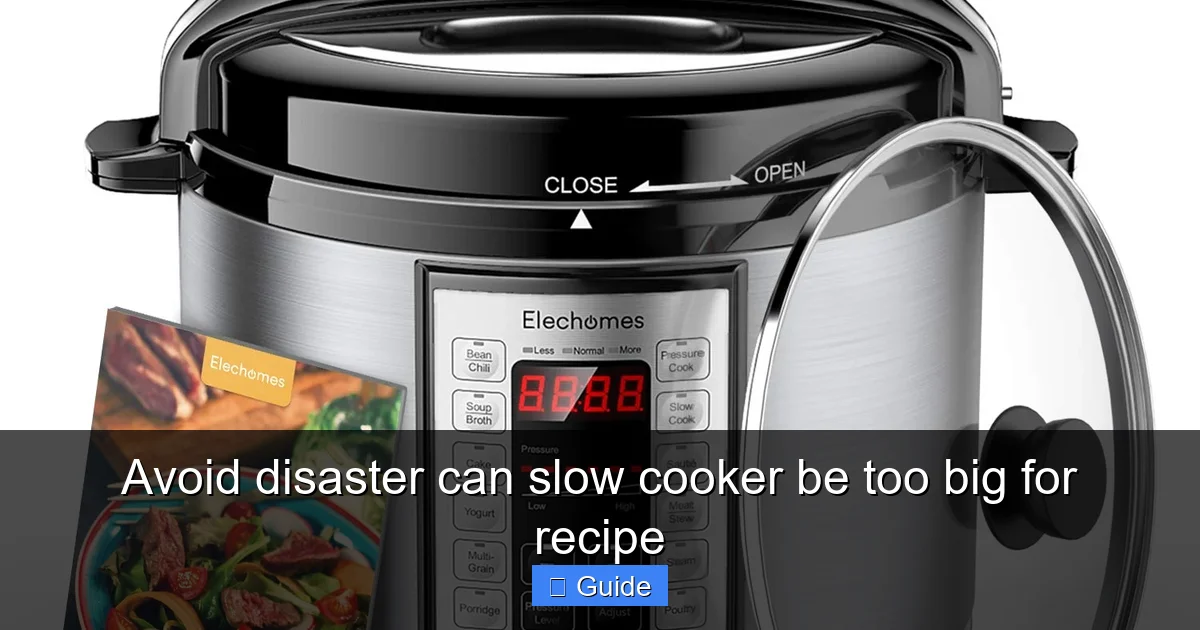
If your slow cooker is too big for the recipe, the food may cook slowly, dry out, or heat unevenly. In a U.S. kitchen, the safest fix is to use a smaller slow cooker that lets the food fill about one-half to two-thirds of the crock. If that is not possible, increase the recipe only when the ingredients, cook time, and slow cooker manual support it. Do not use a large cooker for a small batch without checking the manufacturer’s instructions.
A slow cooker needs enough food in the crock to transfer heat well. A thin layer can lose moisture before the center reaches a safe temperature. This is both a quality problem and, in some cases, a food-safety concern.
Why a Slow Cooker That Is Too Big Causes Problems
A slow cooker that is too large spreads the food across a wide, shallow area. This changes the way heat moves through the meal.
Most slow cookers heat from the sides and bottom. The crock, food, liquid, and lid work together to build steady heat. When the recipe fills only a small part of the crock:
- The food layer may be too thin.
- More surface area is exposed to heat and evaporation.
- Meat can dry out before it becomes tender.
- Vegetables may cook at different rates.
- The cooker may take longer to reach a safe cooking temperature.
- The recipe may not match the timing stated by its author.
A large slow cooker does not always cook faster. The outcome depends on the model, food volume, ingredient size, starting temperature, and recipe. Changing from a 4-quart cooker to an 8-quart cooker can produce a very different result even when the setting stays on “Low.”
What “too big” means
A slow cooker is usually too big when the food does not reach the fill level recommended by the manual. Many manufacturers advise filling the crock about one-half to two-thirds full. Some manuals allow a different range, so the instructions for your exact model take priority.
A cooker may also be too big when:
- The recipe contains only one or two servings.
- The food forms a thin layer across the bottom.
- The meat sits far from the liquid or sauce.
- The lid does not trap enough moisture for the small batch.
- The recipe was designed for a different crock size.
The best test is not the cooker’s label alone. It is the depth and amount of food inside the crock.

How to Fix a Recipe in an Oversized Slow Cooker
The safest and most reliable fix is to use a smaller slow cooker. If you only have a large model, choose one of the following options based on the recipe.
1. Use a smaller slow cooker
A smaller crock gives the food the proper depth and helps reduce moisture loss. Match the cooker to the batch rather than forcing a small recipe into a large appliance.
As a rough planning guide:
| Recipe size | Often suitable slow cooker size |
|---|---|
| 1–2 servings | 1.5–3 quarts |
| 3–4 servings | 3–4 quarts |
| 5–6 servings | 5–6 quarts |
| Large family batch | 6–8 quarts |
These are general planning ranges, not universal rules. A stew with large meat pieces may need a different size than a dip or breakfast dish. Always check the recipe and appliance manual.
2. Scale the recipe up carefully
If the cooker is too large, you may be able to make a larger batch. This works best for soups, chili, beans, shredded meat, and stews.
Do not simply double every ingredient without considering:
- The maximum fill line.
- The size of meat pieces.
- The amount of liquid.
- The cooking time.
- The time needed for the center to heat.
- The final seasoning level.
For example, doubling a chili recipe may work well if the finished mixture remains below the maximum fill line. Doubling a roast may not work because two large pieces can block heat flow and require different cooking time.
Use a food thermometer to check the thickest part of meat. For poultry, the USDA advises cooking to 165°F. Whole cuts of pork, beef, veal, and lamb should reach at least 145°F, followed by a three-minute rest. Ground meats should reach 160°F. These temperatures are general U.S. food-safety targets, not a substitute for the recipe or appliance directions.
3. Cook the recipe in a pot or pan instead
A stovetop pot, Dutch oven, or covered oven-safe dish may give better control than an oversized slow cooker. This is useful when the food forms a very shallow layer or when the recipe needs browning and reduction.
Use a method designed for that appliance. Slow-cooker timing does not transfer directly to a stovetop or oven. Keep the food at a safe cooking temperature, and use a thermometer when the recipe contains meat, poultry, seafood, eggs, or other perishable foods.
4. Split the batch
For a large amount of food, divide the recipe between two compatible slow cookers. This creates a better food depth and can improve heating.
Do not divide the recipe if you cannot monitor both cookers safely. Place each appliance on a stable, heat-safe surface with space around it. Avoid extension cords unless the appliance manual specifically permits them.
5. Do not fill the empty space with random objects
Do not place foil balls, towels, cans, or improvised containers around the food to make a large crock seem smaller. These items can affect heat flow, block the lid, damage the appliance, or create a fire risk.
A separate slow-cooker divider or smaller insert is only suitable if the manufacturer designed or approved it for your exact model. A heat-safe bowl placed inside the crock is not automatically safe. It may block the heating surface or change the way heat reaches the food.

Can You Use a Slow Cooker That Is Too Big for Meat?
You can use a large slow cooker for meat only when the food reaches the manufacturer’s recommended fill level and the meat has enough surrounding liquid or sauce. A single small roast in a very large crock is often a poor match.
Meat may become dry because the exposed surface loses moisture while the center is still cooking. This is especially likely with lean cuts, boneless chicken breast, and small portions.
For better results:
- Choose a slow cooker that fits the size of the meat.
- Cut vegetables into similar-sized pieces.
- Place dense vegetables near the bottom.
- Add the recommended liquid or sauce.
- Keep the lid closed during cooking.
- Check the meat with a thermometer rather than relying only on time.
- Refrigerate leftovers within two hours, or within one hour if the room is above 90°F, according to USDA guidance.
A larger cooker may work well for pulled pork, a full chicken, or a large pot roast when the food fills the crock properly. It is less suitable for a small steak, one chicken breast, or a small serving of stew.
Should you add more liquid?
Add liquid only when the recipe calls for it or when the extra ingredients require it. More liquid does not solve every oversized-cooker problem.
Slow cookers lose less liquid than uncovered stovetop pots. Too much liquid can make the meal watery, dilute flavor, and prevent sauces from thickening. If the food is too shallow, adding liquid may also leave the meat partly submerged without fixing the heating issue.
The right amount depends on the dish. Beans, grains, and dried pasta need enough liquid to hydrate. A roast may need only a small amount of broth, sauce, or cooking liquid.
Can You Put a Smaller Dish Inside a Large Slow Cooker?
Do not place a smaller dish inside a large slow cooker unless the slow cooker manufacturer specifically approves that method. The inner crock is part of the appliance’s heat system. A separate bowl may crack, block heat, trap moisture, or prevent the lid from sealing.
Some slow cookers are designed with divided inserts or casserole-style accessories. Those are different from ordinary glass, ceramic, or metal dishes. Follow the manual for the exact model.
A covered baking dish inside a slow cooker can also create an uncertain temperature pattern. The food may not heat at the same rate as food placed directly in the matching crock. If the manual does not describe the method, use a smaller slow cooker or another cooking method instead.
Are slow-cooker liners a solution?
No. A liner can make cleanup easier, but it does not change the size of the crock. It will not make a large slow cooker heat a small batch like a smaller model.
Use only liners labeled for slow-cooker use. Keep the liner inside the crock, do not lift the liner full of hot food, and follow the liner packaging and appliance instructions.
How to Adjust Cooking Time in a Large Slow Cooker
Do not assume that a larger slow cooker needs a shorter cooking time. The key issue is food depth and volume, not the cooker’s outside size alone.
A small batch in a large crock may heat unpredictably. A larger batch may take longer to reach a safe temperature in the center. Recipe times are estimates because slow cookers vary in wattage, design, lid fit, and temperature control.
Use this process:
- Start with the recipe’s recommended setting and time.
- Avoid opening the lid during the first part of cooking.
- Check the food when it should be close to done.
- Measure the internal temperature of meat and poultry.
- Check texture, such as tender beans or soft vegetables.
- Continue cooking if the food has not reached the needed temperature or texture.
- Discard food that has remained lukewarm for an unsafe period.
A slow cooker should bring food to a safe cooking temperature and keep it hot during cooking. If the food remains lukewarm for a long time, do not assume that extra hours will make it safe. When in doubt, follow the USDA’s food-safety guidance or discard the food.
Can you cook a small amount on High?
The “High” setting is not a universal fix for an oversized crock. It may change the heating rate, but it does not guarantee even cooking or compensate for poor food depth.
Do not switch settings only to shorten the recipe unless the recipe or appliance manual gives that option. Some foods can scorch on the edges while the center remains undercooked.
How to Choose the Right Slow Cooker Size
Choose a slow cooker based on the batch size, food type, and required depth.
A useful approach is to estimate the finished volume, then select a crock that will be comfortably filled without reaching the maximum line. Leave space for bubbling and expansion.
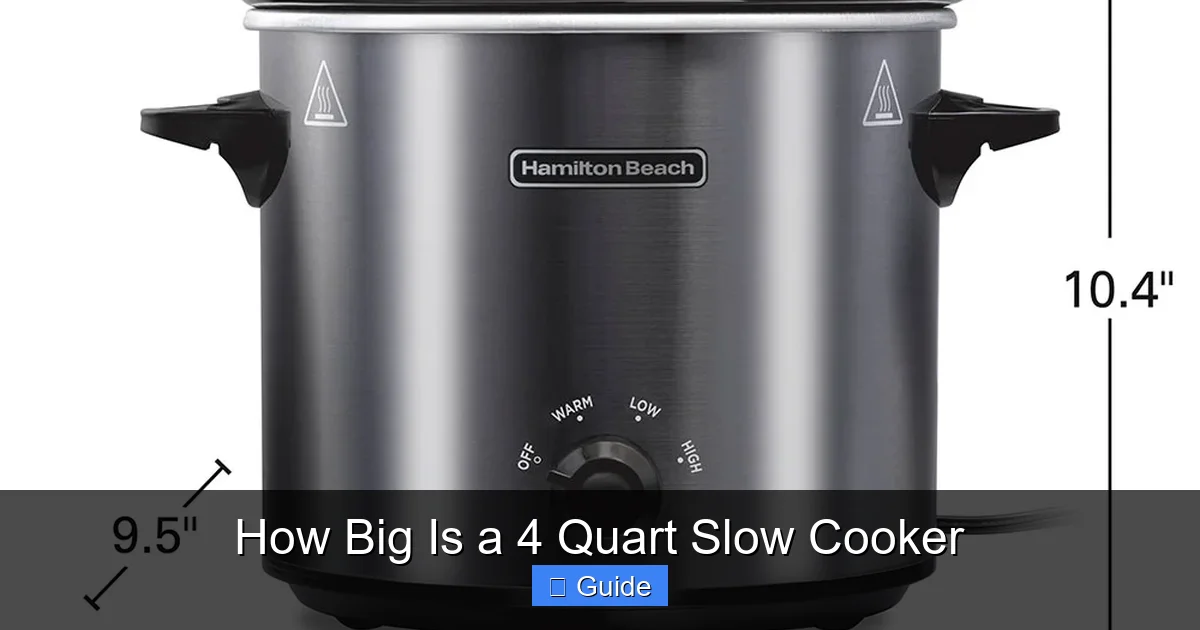
For example, a hypothetical 2-quart soup recipe should not be placed in an 8-quart cooker unless the manufacturer allows that fill level and the food still has enough depth. A 4-quart cooker may be a better fit, depending on the shape of the crock.
Consider these factors:
- Serving size: Small households often benefit from a 2- to 4-quart cooker.
- Recipe type: Dips and sauces may need less capacity than roasts.
- Food shape: A long roast may need a wide crock.
- Leftovers: A larger batch can be practical if it fills the cooker safely.
- Storage: Leftovers should be cooled and refrigerated in shallow containers.
- Manual instructions: The model’s fill range is the final reference.
A cooker that is slightly larger than the recipe is usually easier to manage than one that is dramatically larger. The food should have room to cook but should not sit as a thin film across the bottom.
Common Mistakes to Avoid
Avoid these mistakes when a slow cooker is too big:
- Cooking a tiny batch in a large crock without checking the fill level.
- Adding extra water just to raise the food level.
- Doubling meat without checking the center temperature.
- Using a random bowl or pan as a smaller insert.
- Removing the lid often to check progress.
- Using frozen meat when the recipe or manual requires thawed meat.
- Leaving cooked food on “Warm” for an unknown length of time.
- Cooling a large, deep container of leftovers slowly.
- Assuming “Low” and “High” settings are the same across brands.
For leftovers, divide large amounts into shallow containers so they cool more quickly. Refrigerate them promptly, and use a refrigerator thermometer and food-safety guidance when storage time is uncertain.
Quick Decision Table
| Situation | Best action |
|---|---|
| Food fills less than half the crock | Use a smaller slow cooker or split the batch |
| Food fills half to two-thirds of the crock | Follow the recipe and manual; check doneness |
| Food reaches the maximum line | Remove some food before cooking |
| A small roast sits in a very large crock | Use a smaller cooker or another cooking method |
| You want to use a bowl inside the crock | Do so only if the manufacturer approves it |
| The food stays lukewarm | Stop and assess food safety; do not rely on extra cooking time |
| The meal is dry but fully cooked | Reduce surface exposure, use a better-sized crock, and follow the recipe’s liquid guidance |
| The recipe is doubled | Confirm capacity, liquid, ingredient size, and center temperature |
Frequently Asked Questions
What happens if a slow cooker is only one-quarter full?
A one-quarter-full slow cooker may heat unevenly and lose moisture quickly. The food may also cook differently from the recipe’s stated time. Use a smaller cooker when possible. If you proceed, follow the manual and verify the food’s internal temperature.
Can I use an 8-quart slow cooker for a 2-quart recipe?
You can, but it is usually not the best choice. The food may form a shallow layer, dry out, or heat less predictably. A 3- or 4-quart slow cooker is often a better match, depending on the recipe and required food depth.
Does a bigger slow cooker use more electricity?
A larger cooker may have a different wattage, but energy use depends on the model, setting, cooking time, and how often it cycles. Do not choose a cooker size based on capacity alone. Check the appliance label or manual for its rated wattage.
Can I leave the lid off if the slow cooker is too big?
No. Removing the lid increases heat and moisture loss. It can also lengthen cooking time and make safe temperature control less reliable. Keep the lid closed unless the recipe directs you to open it.
Is it safer to cook a small batch on High?
Not necessarily. High heat may reduce cooking time for some recipes, but it does not correct an unsuitable fill level. Follow the recipe and manufacturer’s directions, and use a thermometer for meat and poultry.
Final Answer
If your slow cooker is too big, the best solution is to use a smaller cooker that holds the food about one-half to two-thirds full. If you must use the large model, make a properly sized batch, stay below the maximum fill line, follow the manual, and check the food with a thermometer.
Do not solve the problem with extra liquid, an unapproved inner bowl, or a guessed cooking time. Match the cooker to the food, keep the lid closed, and treat any meal that stays lukewarm as a food-safety concern.