Introduction
On most electric skillets, a simmer is reached by setting the temperature to about 200°F to 250°F. Start near 225°F, then adjust as needed. The liquid should have small, gentle bubbles—not a fast boil.
The exact setting varies by skillet. An electric skillet measures heat at the pan, while the food temperature changes with the amount of liquid, the lid, the ingredients, and the room temperature. For the best result, use the dial as a starting point and judge the liquid by its bubbles.
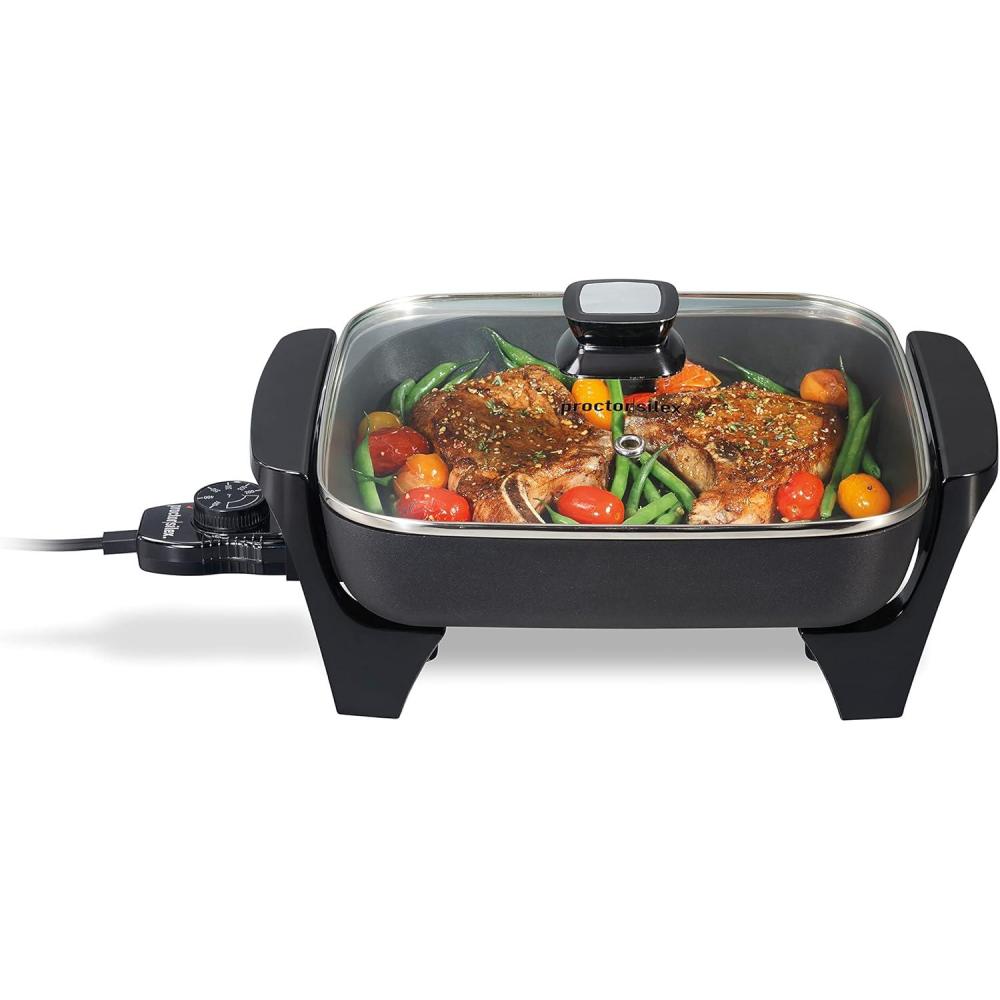
What Temperature Is Simmer on an Electric Skillet?
A simmer usually means that a liquid stays just below a full boil. At sea level in the United States, water boils at about 212°F. A simmer often falls between 185°F and 205°F, although the food may simmer at a slightly different temperature depending on its ingredients.
For an electric skillet, use these settings as a practical guide:
| Electric skillet setting | Likely result | Best use |
|---|---|---|
| 200°F | Very gentle simmer or hot hold | Sauces, delicate foods, slow warming |
| 225°F | Gentle simmer | Soups, beans, gravy, braising |
| 250°F | Active simmer | Foods that need faster cooking |
| 275°F or higher | Strong simmer or low boil | Reducing liquid or starting a boil |
| 300°F or higher | Frying or sautéing range | Browning meat and vegetables |
These numbers are not universal. Some skillet dials show low, medium, and high rather than exact temperatures. Other models begin at 200°F or use a thermostat that cycles on and off.
The safest answer is simple: set the skillet near 225°F, wait for the liquid to heat, and lower or raise the setting until you see gentle bubbles.
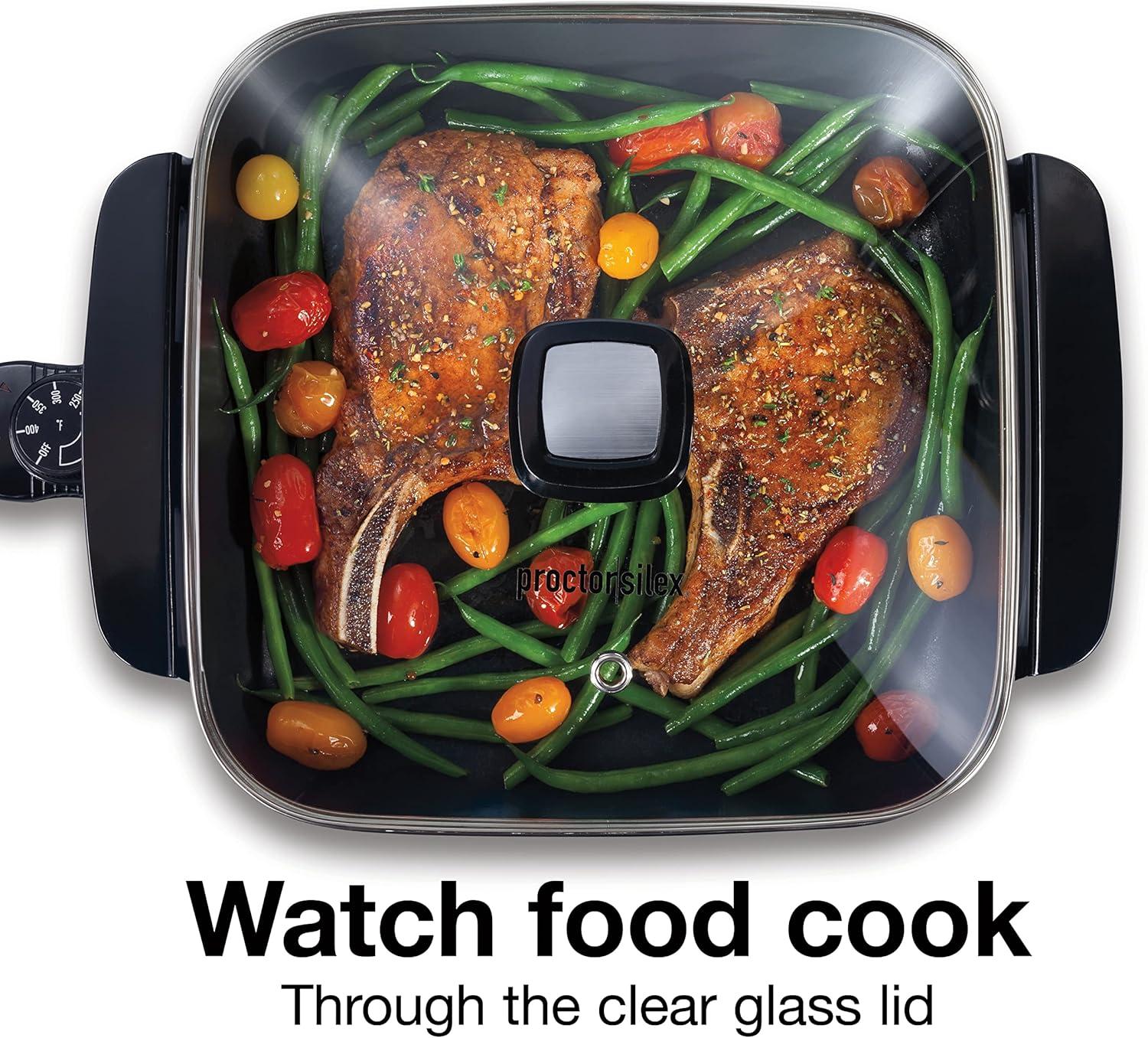
How to Simmer in an Electric Skillet
Follow these steps when you need to simmer soup, sauce, stew, beans, or another liquid-based dish.
-
Add the food and liquid to the skillet.
Do not fill the pan beyond the manufacturer’s maximum-fill line. If the skillet has no marked line, leave enough space to prevent splashes when the food bubbles. -
Set the temperature to 250°F.
This helps the liquid heat without taking too long. Keep the lid on if the recipe calls for covered cooking. -
Wait until the liquid begins to bubble.
Heating may take several minutes. The time depends on the amount of food, whether it started cold, and the skillet’s wattage. -
Lower the setting to about 200°F to 225°F.
Make this adjustment once you see steady bubbles around the edges or across the surface. -
Watch the bubbles for several minutes.
A simmer should look calm. You should see small bubbles rise at a steady rate. The surface should not roll or splash hard. -
Adjust in small steps.
Raise the setting by 25°F if the liquid stops bubbling. Lower it by 25°F if the food begins to boil rapidly. -
Stir when the recipe requires it.
Thick sauces, dairy-based foods, and foods with starch can stick even at a low temperature.
A simmer is a visual cooking stage, not just a number on the dial. Think of the setting as the skillet’s rough map and the bubbles as the road signs.

How to Tell if Food Is Simmering
A simmer has small, gentle bubbles that rise slowly and break near the surface. Steam may appear, but the liquid should not splash or move in large waves.
Use these signs to check the heat:
- No bubbles: The heat may be too low, or the food may still be warming.
- Small bubbles at the edge: The food is at a gentle simmer.
- Small bubbles across the surface: The food is at a steady simmer.
- Large bubbles with strong movement: The food is close to or at a boil.
- Foam or splashing: The heat may be too high, especially with starchy foods.
- Food sticking to the bottom: The skillet may be too hot, the mixture may be too thick, or it may need stirring.
Do not rely on steam alone. A covered skillet can produce heavy steam even when the liquid is not boiling. Remove the lid carefully, because hot steam can burn skin.
For greater accuracy, use a food thermometer to check the food itself. A thermometer can help confirm the temperature, but it does not replace visual checks for the cooking action you want.

Electric Skillet Simmer Settings for Common Foods
Different foods need different simmer levels. A delicate sauce may scorch at the same setting that works well for a thin soup.
| Food | Starting setting | What to look for |
|---|---|---|
| Tomato sauce | 200°F–225°F | Occasional small bubbles |
| Gravy | 200°F–225°F | Gentle bubbling with frequent stirring |
| Soup | 225°F–250°F | Small bubbles throughout the liquid |
| Stew | 225°F–250°F | Slow bubbles without hard boiling |
| Beans | 225°F–250°F | Gentle bubbles and tender cooking |
| Rice | Follow the recipe | Low heat after the liquid reaches a boil |
| Poached eggs | About 200°F | Very gentle movement; no rolling boil |
| Cheese sauce | 175°F–200°F | Smooth heat with no hard bubbling |
| Braised meat | 225°F–250°F | Low, steady bubbling with the lid on |
These ranges are starting points, not fixed rules. A thick sauce usually needs less heat than a thin soup because it transfers heat differently and can burn more easily.
When a recipe says “bring to a simmer,” heat the food at about 250°F until bubbles appear. Then reduce the setting to 200°F to 225°F so the food stays at a gentle simmer.

Why the Dial Setting May Not Match the Food temperature
an electric skillet’s dial usually controls the heating element or thermostat. It does not always show the exact temperature of the liquid in the pan.
Several factors can change the result:
- Skillet design: Heating elements and thermostat locations differ by model.
- Amount of food: A full skillet takes longer to heat and may need a higher setting.
- Starting temperature: Refrigerated food needs more time than room-temperature food.
- Lid position: A lid traps heat and steam, which can make the food simmer faster.
- Food thickness: Thick mixtures heat and move differently from thin liquids.
- Stirring: Stirring spreads heat and can reduce hot spots.
- Altitude: Water boils at a lower temperature at higher elevations.
- Thermostat cycling: The heater may turn on and off to maintain its target range.
Because of these differences, a setting of 225°F on one electric skillet may act more like 200°F or 250°F on another. Your owner’s manual is the best source for model-specific guidance.
If your skillet has a temperature probe, keep it properly seated. A loose probe can cause uneven heating or incorrect temperature control.

Simmering Without Burning or Boiling Over
To keep a simmer stable, begin with moderate heat and make small adjustments. Do not turn the skillet to high and leave it unattended while waiting for the liquid to heat.
Use these tips:
- Keep thick foods on the lower end of the range.
- Stir sauces and gravies often.
- Use a lid when the recipe needs moisture to stay in the pan.
- Leave the lid partly open if the food is close to boiling over.
- Reduce the heat if bubbles become large or violent.
- Add cold liquid carefully because hot mixtures can splash.
- Use heat-resistant utensils made for the skillet’s cooking surface.
- Avoid dragging metal tools across a nonstick surface.
If food begins to burn, move the skillet to a safe, heat-resistant area if the design allows it, turn off the power, and do not scrape the burned layer into the rest of the food. Never pour water into hot oil or a hot grease mixture.

Simmering and Food Safety
A simmer is a cooking method, but it is not a universal food-safety test. Food can appear to simmer while the center remains below a safe temperature.
For meat, poultry, seafood, eggs, and leftovers, use a clean food thermometer and follow current USDA guidance. USDA recommends cooking poultry and reheating leftovers to 165°F. Ground meats generally need to reach 160°F, while whole cuts of beef, pork, veal, and lamb generally need to reach 145°F, followed by a rest period.
The thermometer should measure the thickest part of the food and should not touch the skillet surface. This matters because the pan may be much hotter than the center of a thick stew or meat portion.
Keep perishable food out of the temperature danger zone as much as possible. If you are holding food for serving, use a method that keeps it safely hot rather than assuming a low simmer is enough.
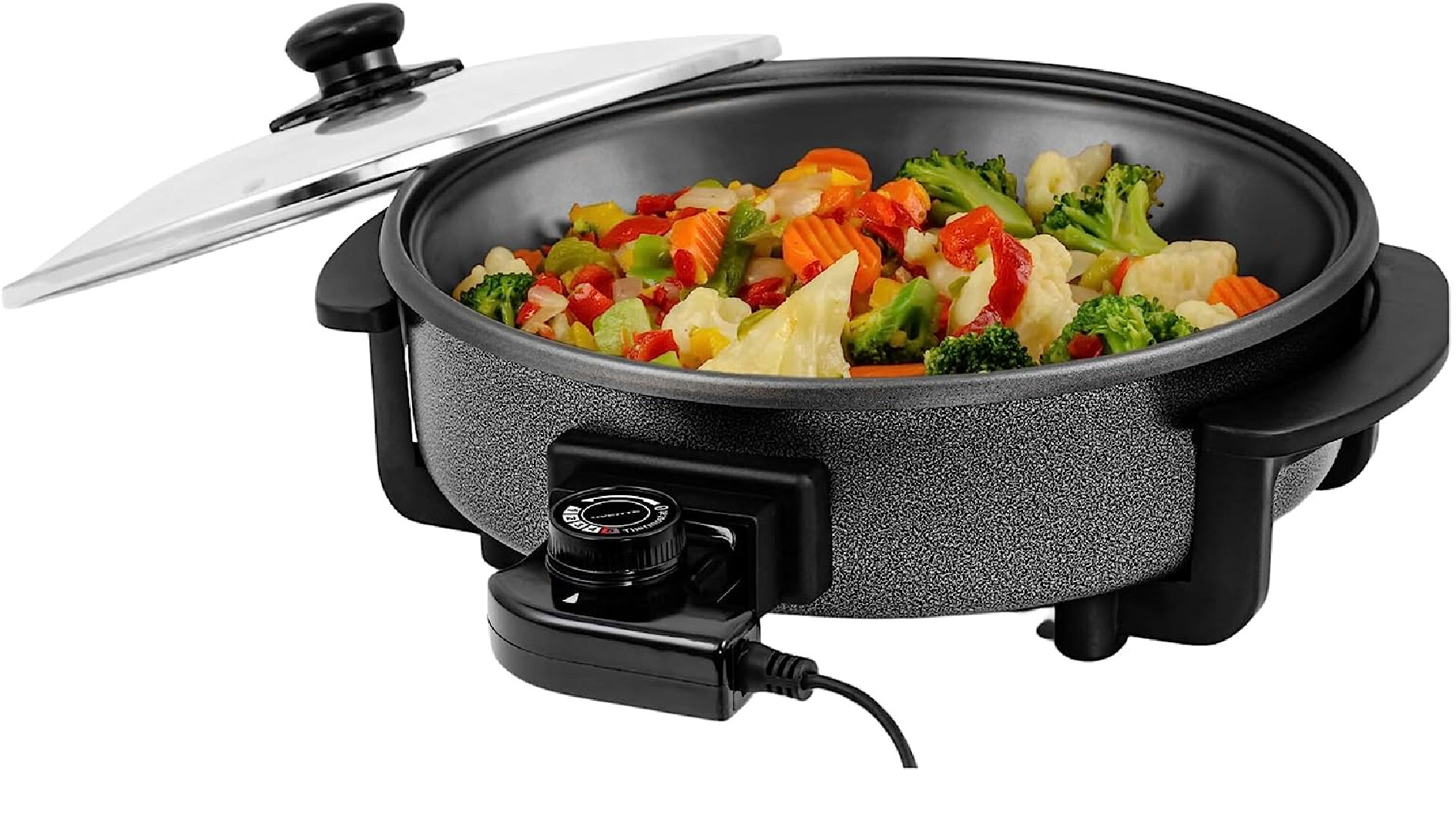
Common Mistakes When Using an Electric Skillet
Treating 200°F as the same on every skillet
A dial setting is not a guarantee that the food has reached that exact temperature. Always check the food’s behavior and adjust the heat.
Using high heat to start every recipe
High heat may bring liquid to a boil quickly, but it can scorch milk, cheese, tomato sauce, and thick mixtures. Moderate heat gives you more control.
Confusing a boil with a simmer
A boil has large, rapid bubbles and strong movement. A simmer has smaller bubbles and gentle movement. If a recipe calls for a simmer, reduce the heat as soon as the liquid begins to boil.
Leaving a covered skillet unattended
A lid can speed heating and increase the risk of boiling over. Stay nearby, especially when cooking thick or starchy food.
Filling the skillet too high
Overfilling can cause spills and uneven heating. Follow the fill limit in the manual and leave room for bubbling.
Using the skillet as a slow cooker without checking the manual
Some electric skillets maintain low heat well, while others cycle too broadly for long, unattended cooking. Use the manufacturer’s instructions for extended cooking.

What to Do if Your Electric Skillet Will Not Simmer
If the food will not simmer, check the simplest causes first:
- Confirm that the power cord and temperature probe are fully connected.
- Make sure the skillet sits on a stable, level surface.
- Check that the temperature dial is set above the skillet’s minimum heat.
- Remove excess food if the pan is heavily filled.
- Replace a cold lid only after the food has begun heating.
- Stir the mixture so cold spots do not hide the true temperature.
- Raise the setting by 25°F and wait several minutes.
If the skillet becomes extremely hot, smells like burning plastic, sparks, or fails to cycle normally, turn it off and unplug it when safe. Do not use a damaged cord, plug, probe, or control unit. Contact the manufacturer or a qualified appliance repair professional if the problem continues.

Frequently Asked Questions
Is 200°F enough to simmer in an electric skillet?
It may be enough for a gentle simmer, especially with a lid and a small amount of liquid. Some skillets run cooler or cycle below the dial temperature. If there are no small bubbles after the food has had time to heat, raise the setting toward 225°F or 250°F.
Is 250°F too hot for simmering?
Not always. A setting of 250°F can work for soup, stew, or a thin sauce. It may be too hot for cheese sauce, milk-based food, or thick gravy. Lower the temperature if the liquid boils hard or the bottom begins to stick.
Can I simmer food in an electric skillet with the lid on?
Yes, if the recipe calls for covered cooking and the skillet has enough room. A lid holds in heat and moisture, so you may need to lower the temperature. Check often for boiling over.
How long does it take an electric skillet to reach a simmer?
It depends on the skillet, food volume, lid use, and starting temperature. A small amount of room-temperature liquid may heat in a few minutes, while a full skillet of refrigerated food can take much longer. Watch the food rather than relying on a fixed time.
What is the best temperature for simmering tomato sauce?
Start around 225°F, then lower toward 200°F once small bubbles appear. Stir the sauce often because its thickness and natural sugars can make it stick or scorch.
Conclusion
For most electric skillets, 225°F is a useful starting point for simmering. Use 200°F to 225°F for delicate sauces and gentle cooking, and 225°F to 250°F for soups, stews, and foods that need a stronger simmer.
The best test is the food itself: look for small, steady bubbles and gentle movement. Adjust the dial in small steps, use the owner’s manual for model-specific limits, and check meat and leftovers with a food thermometer.
For your next recipe, set the skillet to 225°F, wait for small bubbles, then lower or raise the heat until the liquid stays calm without reaching a rolling boil.