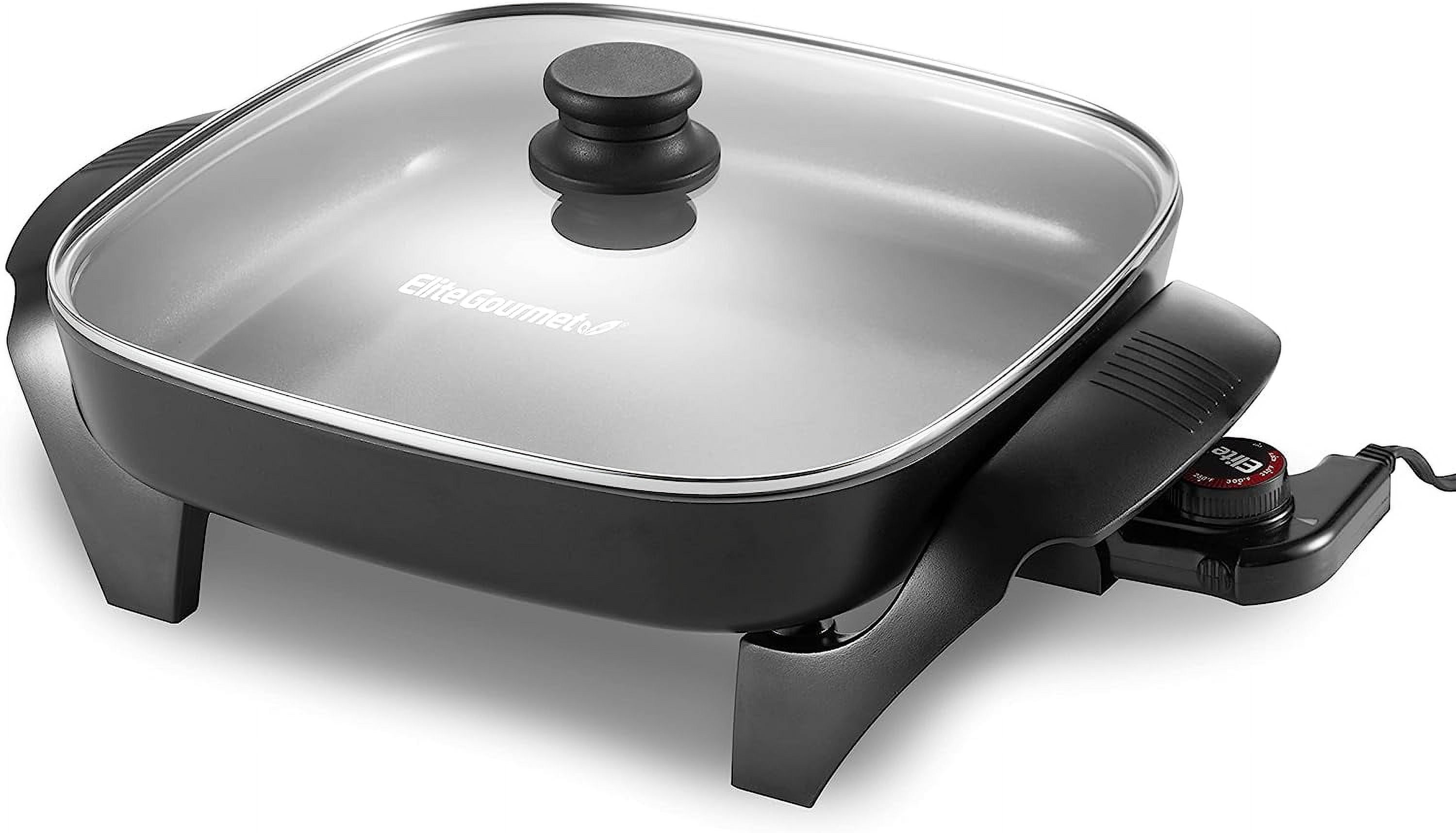
An electric skillet is a countertop cooking pan with a built-in electric heating element and an adjustable thermostat. In the United States, it plugs into a standard household outlet and lets you fry, sauté, sear, simmer, roast, or keep food warm without using a stovetop burner.
Unlike a regular frying pan, an electric skillet makes its own heat. It usually has a removable temperature probe, a glass lid, side handles, and a wide cooking surface. Some models have tall sides for cooking stews or large meals.
An electric skillet can help when your stove is busy, your kitchen has limited burner space, or you need steady heat for a long cook. Its main limits are its size, cord, cleaning needs, and the fact that many models cannot go in the oven.

How Does an Electric Skillet Work?
An electric skillet works by sending power from an outlet to a heating element beneath the cooking surface. A thermostat senses the temperature and turns the heat on and off to help maintain the selected setting.
Most electric skillets have these parts:
- Cooking pan: The metal pan holds the food.
- Heating element: This creates heat below the pan.
- Thermostat: This controls the selected temperature.
- Temperature probe: This connects the skillet to the power cord and control dial.
- Lid: This helps hold heat and moisture.
- Handles: These make the hot pan easier to move.
- Nonstick coating: Many models use a coated surface to reduce sticking.
The thermostat does not always keep the pan at one exact temperature. It cycles the heating element on and off. The actual temperature can change based on the food amount, lid use, room temperature, and skillet design.
Many U.S. electric skillets offer settings from warm to about 400°F or 450°F. The exact range depends on the model. Always use the manual for the correct temperature limits.
What Can You Cook in an Electric Skillet?
An electric skillet can cook many foods that you would prepare in a frying pan, sauté pan, or shallow pot. It works best for foods that need a broad, flat surface and steady heat.
Common uses include:
- Eggs, bacon, sausage, and pancakes
- Burgers and grilled sandwiches
- Chicken, pork chops, and fish
- Stir-fry vegetables
- Hash browns and roasted potatoes
- Rice dishes and pasta meals
- Chili, beans, and other shallow stews
- French toast and other breakfast foods
- Fried foods, when the model and manual allow it
- Keeping cooked food warm for serving
The wide base is useful for foods that need room. For example, several chicken breasts may brown more evenly in a large skillet than in a small frying pan.
A skillet with deep sides can also hold more liquid than a standard frying pan. However, it is not a full replacement for a stockpot, Dutch oven, or oven-safe braiser.
Electric Skillet vs. Regular Skillet
The main difference is the heat source. A regular skillet needs a stovetop burner. An electric skillet has its own heating system and plugs into an outlet.
| Feature | Electric skillet | Regular skillet |
|---|---|---|
| Heat source | Built-in electric element | Stovetop burner |
| Temperature control | Thermostat dial or digital control | Stove setting |
| Portability | Useful near an outlet | Needs a stove or compatible burner |
| Cooking area | Often wide and shallow | Varies by pan |
| Oven use | Often limited or not allowed | Depends on the pan |
| Cleaning | May have a removable probe | Usually simple stovetop cleaning |
| Heat behavior | Cycles to hold a set temperature | Depends on the burner and pan |
| Storage | Takes more space because of the control parts | Usually easier to stack |
An electric skillet may be the better choice when you need an extra cooking surface. A regular skillet may be better for high-heat searing, oven finishing, or quick stovetop work.
Electric skillets also differ from electric griddles. A griddle usually has a flat, open cooking surface with little or no side wall. An electric skillet has raised sides and often includes a lid. A griddle is usually better for pancakes and large batches of bacon. A skillet is more useful for sauces, braises, and foods that release liquid.
What Are the Benefits of an Electric Skillet?
An electric skillet offers practical benefits, but the value depends on how you cook.
Extra cooking space
You can use an electric skillet while the stove handles another dish. This can help during holiday meals, family breakfasts, or large gatherings.
Steady heat
The thermostat can help maintain a selected setting during slow cooking. This is useful for simmering, warming, or cooking foods that need more control than a high burner provides.
A wide cooking surface
Many electric skillets spread heat across a large area. This gives foods more room and can reduce crowding. Less crowding may help meat brown instead of steaming, although results vary by model and food load.
Easy access
The skillet can sit on a sturdy, heat-safe counter near an outlet. This can help people who do not want to reach over a hot stove or who have limited kitchen space.
Useful for serving
Some models can keep food warm after cooking. Use the warm setting only as directed by the manufacturer. For food safety, do not assume that a warm setting will rapidly heat cold food or safely hold food forever.

What Are the Limitations?
An electric skillet is useful, but it is not a universal cooking tool.
It needs an outlet
The cord can limit where you use the skillet. Keep the cord away from hot surfaces, sinks, walkways, and children.
It may not heat like a stovetop pan
Some electric skillets heat more slowly or recover more slowly after cold food is added. The cooking surface may also have warmer and cooler areas.
Oven use is often restricted
The pan, lid, probe, and handles may not be oven-safe. Some removable pans are oven-safe only within a stated temperature limit. Never place the electrical control or cord in an oven.
High-heat searing may be limited
Many electric skillets are designed for moderate cooking temperatures. If you want a hard sear, check the stated maximum temperature and use a pan made for that purpose.
The coating needs care
Metal tools, abrasive pads, and overheating can damage a nonstick surface. Follow the care instructions for the exact model.
It takes storage space
An electric skillet is often wider and deeper than a standard pan. Measure your cabinet before buying one.
How to Use an Electric Skillet Safely
Use the electric skillet on a stable, dry, heat-resistant surface. Keep it away from the edge of the counter, and make sure the control probe is fully inserted before switching it on.
Follow these basic steps:
- Read the manual first. Check temperature limits, cleaning rules, oven use, and approved accessories.
- Inspect the cord and plug. Do not use the skillet if the cord, probe, or housing is cracked, burned, or damaged.
- Place the skillet on a level surface. Do not use it on a wet counter or unstable table.
- Add food after preheating when the recipe calls for it. Preheating can improve browning.
- Avoid overfilling the pan. Too much food can lower the temperature and increase spill risk.
- Use suitable tools. Silicone, wood, or approved nylon tools are usually safer for coated surfaces.
- Keep the lid vent in mind. Steam can cause burns when you lift the lid.
- Unplug the skillet after use. Let it cool before cleaning.
- Keep the electrical parts dry. Never immerse the cord, plug, thermostat, or control probe unless the manual specifically permits it.
For food safety, use a food thermometer rather than color alone. The U.S. Department of Agriculture lists these minimum internal temperatures:
- Poultry: 165°F
- Ground meats: 160°F
- Whole cuts of beef, pork, lamb, and veal: 145°F, followed by a three-minute rest
- Fish: 145°F
Keep perishable food out of the USDA temperature danger zone, which is 40°F to 140°F. Do not use a skillet’s warm setting as a substitute for checking the food’s temperature.

How to Clean an Electric Skillet
Clean the skillet only after it has been unplugged and has cooled. Remove the temperature probe if the design allows it.
A typical cleaning process is:
- Wipe away grease with a paper towel.
- Wash the pan with warm water, mild dish soap, and a soft sponge if the manual allows immersion.
- Clean the lid according to its instructions.
- Wipe the control probe with a damp cloth if it is not washable.
- Dry every part before storage.
- Store the cord and probe without bending or crushing them.
Do not pour cold water into a very hot pan. A sudden temperature change can damage some cookware. Do not use steel wool or harsh cleaners on a nonstick surface unless the manufacturer specifically approves them.
If food sticks, soak the cooled pan with warm, soapy water. Avoid scraping hard with metal tools. A damaged coating, exposed metal, or warped pan is a reason to stop using the appliance and check the manufacturer’s guidance.
What Should You Look for When Buying One?
Choose an electric skillet based on cooking space, cleaning needs, control design, and safety features—not just the highest temperature number.
Size and shape
A small skillet may suit one or two people. A larger model can help with family meals, but it needs more storage space and may take longer to heat.
Measure the usable cooking area, not only the outside dimensions. Tall sides are helpful for sauces and stews. A broad, shallow surface is better for pancakes, burgers, and browning.
Temperature control
A dial is simple and fast. Digital controls may offer clearer settings, timers, or displays. These features can add complexity, so look for controls that are easy to read and clean.
Removable parts
A removable pan or dishwasher-safe part can make cleaning easier. Confirm which parts are actually dishwasher-safe. Do not assume that the electrical probe or control unit can be washed in water.
Lid design
A glass lid lets you check food without releasing as much heat. A vent can help release steam. A lid with a strong handle is easier to lift safely.
Handles and stability
Look for cool-touch handles, a stable base, and a cord that does not pull the skillet toward the edge of the counter.
Coating and materials
Nonstick coatings can make low-fat cooking and cleanup easier. Stainless steel or uncoated surfaces may tolerate more types of tools but can need more oil and care.

Common Electric Skillet Mistakes
Avoiding a few mistakes can improve both results and appliance life.
Overcrowding the pan
Too much food lowers the cooking temperature. Cook in batches when you need browning.
Adding food before the pan is ready
A cold surface can cause sticking and slow cooking. Follow the recipe and manual for preheating.
Using the wrong temperature
A high setting can burn oil or food. A low setting may leave meat undercooked. Use a thermometer for meat and seafood.
Covering food that should brown
A lid traps steam. Use it for simmering and moisture, but remove it when you want a dry, browned surface.
Washing the control unit
Water and electricity are a dangerous combination. Keep the probe, cord, and control housing dry unless the manual clearly says otherwise.
Moving the skillet while it is full
Hot oil, sauce, and food can spill. Turn off the unit, unplug it, and let it cool before moving it.
Assuming “warm” means safe
A warm setting may help hold food, but it does not prove that the food is at a safe temperature. Check with a food thermometer.
Is an Electric Skillet Worth It?
An electric skillet may be worth it if you need extra cooking space, often cook for several people, or want a portable pan that does not depend on a stovetop burner.
It may not be worth the space if you already have a large skillet, griddle, slow cooker, and enough burners. It is also a poor fit if you mainly want oven finishing or very high-heat searing.
A simple decision guide:
| Your main need | Likely best fit |
|---|---|
| Extra burner for family meals | Electric skillet |
| Pancakes and bacon | Electric griddle |
| High-heat searing | Stovetop skillet |
| Long, unattended simmering | Slow cooker |
| Oven-to-table cooking | Oven-safe skillet or Dutch oven |
| Small countertop cooking | Electric skillet, if storage permits |
The best choice depends on the cooking task, available space, and cleaning habits.

Frequently Asked Questions
Can you use an electric skillet like a frying pan?
Yes. You can fry, sauté, brown, and cook many of the same foods. The main difference is that the electric skillet supplies its own heat and may have a different heat response.
Can an electric skillet go in the oven?
Only if the manufacturer says that the specific pan and its removable parts are oven-safe. Never place the cord, thermostat, or electrical control in an oven.
Can you boil water in an electric skillet?
Some deep electric skillets can heat water to a boil, but they may be slower and less suitable than a saucepan. Do not overfill the pan, and follow the manual’s liquid limits.
Can you deep-fry in an electric skillet?
Only when the manufacturer permits it. Use a deep skillet with sufficient side height, avoid overfilling with oil, and keep water away from hot oil. Never leave hot oil unattended.
Are electric skillets safe?
They can be safe when used as directed. Use a sound outlet, keep electrical parts dry, provide ventilation, avoid damaged cords, and supervise hot oil and food.
How long does an electric skillet last?
Service life varies with construction, coating, use, and care. A damaged cord, faulty thermostat, warped pan, or badly worn coating means you should stop using the appliance and contact the manufacturer or replace it.
Key Takeaways
- An electric skillet is a countertop pan with a built-in heating element and thermostat.
- It can fry, sauté, simmer, roast, and keep food warm.
- Its main benefit is extra cooking space away from the stovetop.
- Its main limits are outlet dependence, storage size, cleaning rules, and restricted oven use.
- Use a food thermometer for meat and seafood.
- Keep the electrical probe, cord, and control unit away from water.
- Follow the manual for temperature, oil, dishwasher, and oven instructions.
Conclusion
An electric skillet is a flexible U.S. countertop appliance that combines a wide pan with its own controlled heat source. It works well for family meals, extra cooking space, breakfasts, shallow stews, and foods that benefit from steady heat.
Before buying one, compare its cooking area, temperature range, lid, removable parts, safety features, and storage needs. Before using one, read the manual and keep electrical parts dry. Those simple checks help you get the convenience of an extra burner without treating the skillet as a replacement for every pan in the kitchen.
Sources and Further Reading
- U.S. Department of Agriculture: Safe Minimum Internal Temperatures
- U.S. Department of Agriculture: Keep Food Safe
- U.S. Consumer Product Safety Commission: Home Electrical Safety
- Product manuals for the specific electric skillet model being used, including instructions for cleaning, temperature control, oven use, and dishwasher safety